



New Delhi: For decades, India’s fiscal federal system has had a key element: poor states would be supported so that growth could be shared.The 16th Finance Commission has not broken that promise on paper. States will still receive 41 per cent of the divisible pool of central taxes. But under that headline number, the logic of how money moves across the union is beginning to change.For the first time, economic output changes shape. The long-running revenue deficit grant – which was once a fiscal buffer for states – has been abolished. Some parts of local government funding are now tied to performance standards. Disaster financing is moving toward risk-indexed allocations rather than discretionary relief.This change is subtle in design but significant in outcome. Transfer is no longer limited to just bridging gaps. They are increasingly about shaping behavior – rewarding growth, promoting fiscal discipline and linking public wealth to administrative capacity.Considering the direction of travel, the Commission said, “Considering India’s growth is inevitable, there is a need for at least a small change in the transfer norms towards efficiency.”
What decisions does the Finance Commission take?
Under Article 280 of the Constitution, a Finance Commission is appointed approximately every five years to recommend how the central tax revenue is shared with the states and how that share is distributed among them.The 16th Commission covers the period from 2026-27 to 2030-31. Its recommendations come at a time when India is expected to remain one of the fastest growing major economies and become the world’s third largest economy over the recommended period.

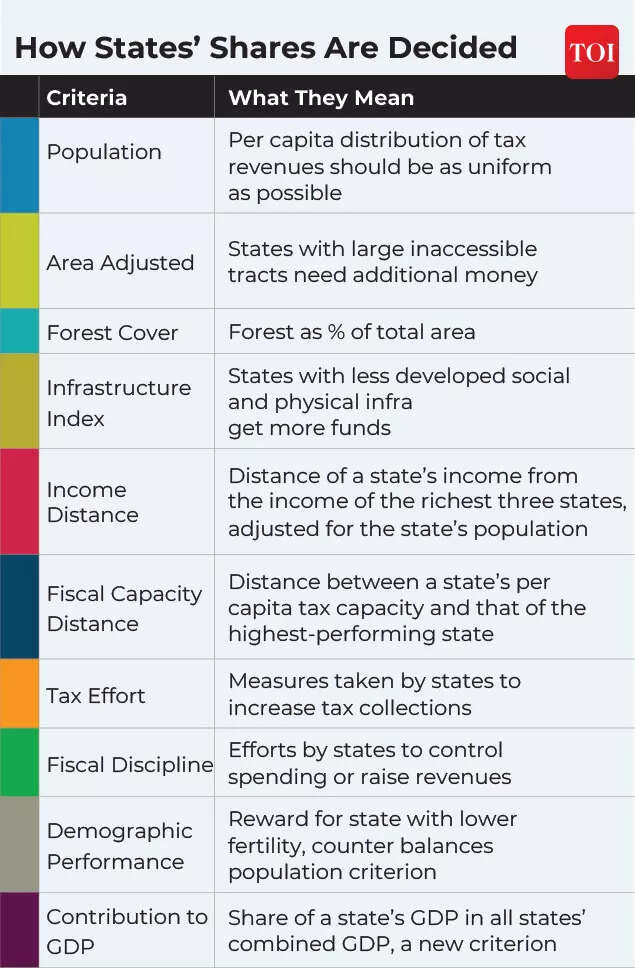
The main decisions are twofold. Vertical transfers determine how much of central taxes go to the states. Horizontal divergence determines how that pool is divided between them. The vertical share remained unchanged. The horizontal structure has changed.

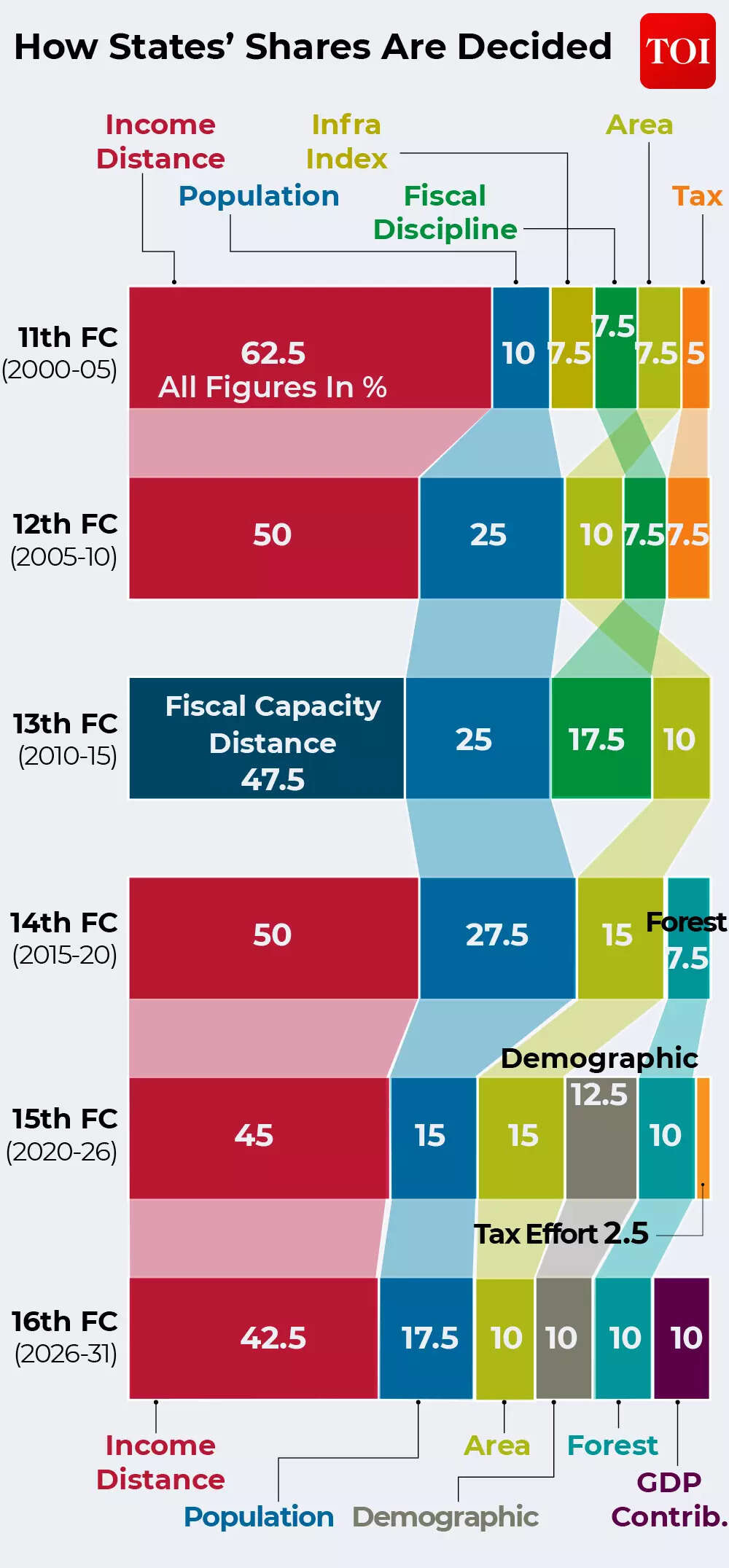
Enters GDP contribution formula
For the first time, contribution to national GDP has been included as a horizontal transfer criterion with a 10 per cent weighting. Karnataka gained 0.48 percentage points. Kerala gained 0.45 percentage points. Madhya Pradesh suffered a loss of 0.50 percentage points. Bihar suffered a loss of 0.11 percentage points. The formula now combines income distance, population, demographic performance, area, forests, GDP contribution. The income gap continues to drive equality. GDP contribution presents an efficiency signal.Responding to TOI’s queries, DK Srivastava, chief policy advisor at EY India, raised the question on ideological grounds.“It does not seem appropriate to link transfers to production efficiency,” he said.He said variations in state GDP contributions reflect structural economic factors rather than fiscal management.Srivastava said, “It is important to distinguish between the efficiency of the production system and the efficiency of the fiscal system. GSDP and GDP are the outcome of the production system in a country which is largely driven by market forces. Inter-state variation in the contribution of a state’s GSDP to the overall GDP largely depends on the inter-state concentration of capital stock, inter-state movement of financial and human resources and state-level availability of infrastructure.”He said that fiscal rules themselves reinforce divergence.“The gap in inter-state infrastructure largely depends on the fiscal deficit ceiling of 3% of GSDP, which by definition is higher for states with higher GSDP,” he said. “Reducing the weighting attached to the income distance criterion and giving relatively greater weight to the contribution criterion would reduce the degree of equality.”Ranen Banerjee, partner and leader, economic advisory, PwC India, said the change sends a policy signal rather than creating an immediate redistributive shock.“Introducing contribution to GDP as a parameter is a bold step as it clearly places the increase in per capita income of citizens and the resulting improvement as a key imperative,” he told TOI.

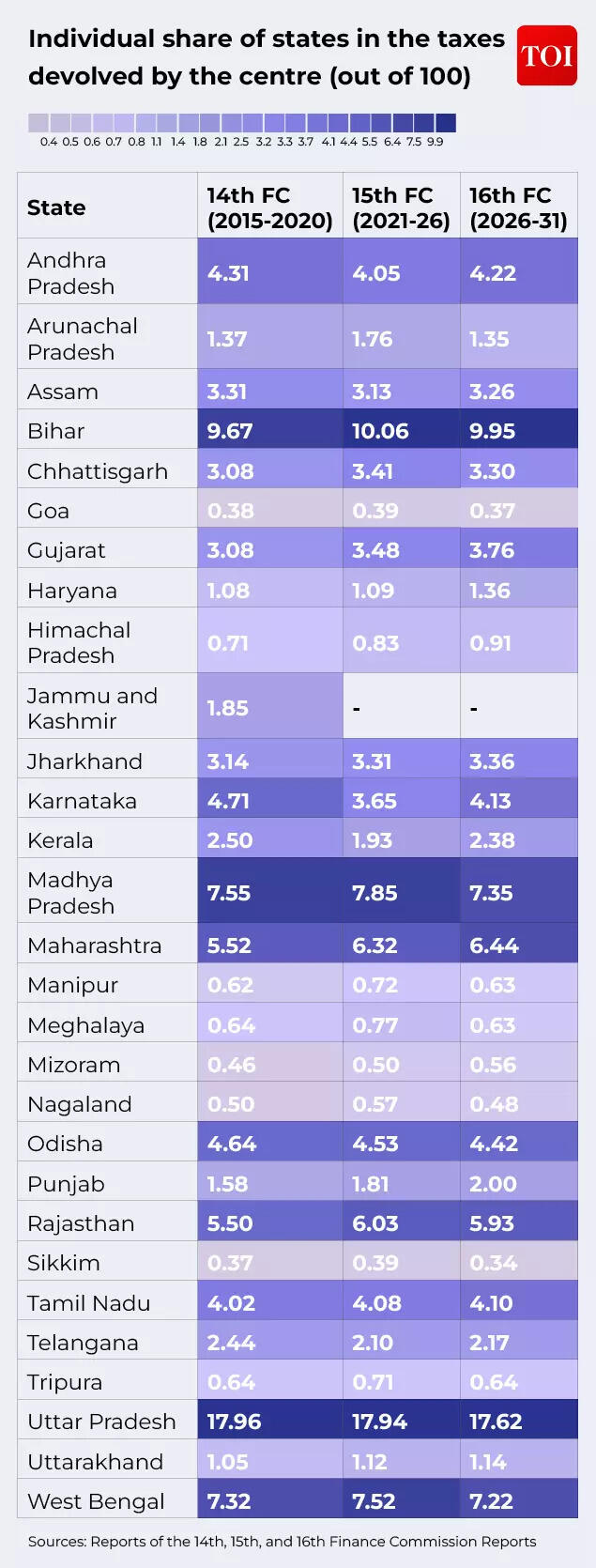
He said states are already competing on development and investment metrics.“States are competing to articulate ambitious development goals while also attracting investment and improving the ease of doing business,” Banerjee said. “Signaling through this indicator could potentially work towards controlling populist spending and encouraging capital output-enhancing spending that boosts economic growth.”He said the numerical impact remains modest.“While this cannot be counted as a structural change, as all changes in the weighting and introduction of this parameter have a peak negative impact of just 50 basis points in a state’s share, it is a huge incentive for states to perform well and deliver growth to their population,” he said.Deloitte India economist Rumki Majumdar said the change formally introduces performance into federal fiscal thinking.“The introduction of the GDP contribution marks an important development: for the first time, economic performance is recognized as measured in horizontal transfers,” he said.
Revenue deficit grant ended
The Commission has completely abolished revenue deficit grants, ending a system historically used to support financially weak states.The Commission’s argument is practical. It argues that continued revenue support created ‘perverse incentive structures’ and weakened fiscal reform pressure.Srivastava said a stronger design could still be built around subsidy discipline.“One possible approach could have been to more clearly exclude excessive or undue subsidies in the assessment of states’ expenditure requirements during the award period,” he said. “Designing calibrated fiscal incentives or disincentives linked to subsidy discipline can enhance accountability.”
Local body transfers: performance matters now
Local bodies will get Rs 7.91 lakh crore between 2026 and 2031, of which 60 percent will go to rural bodies and 40 percent to urban bodies.

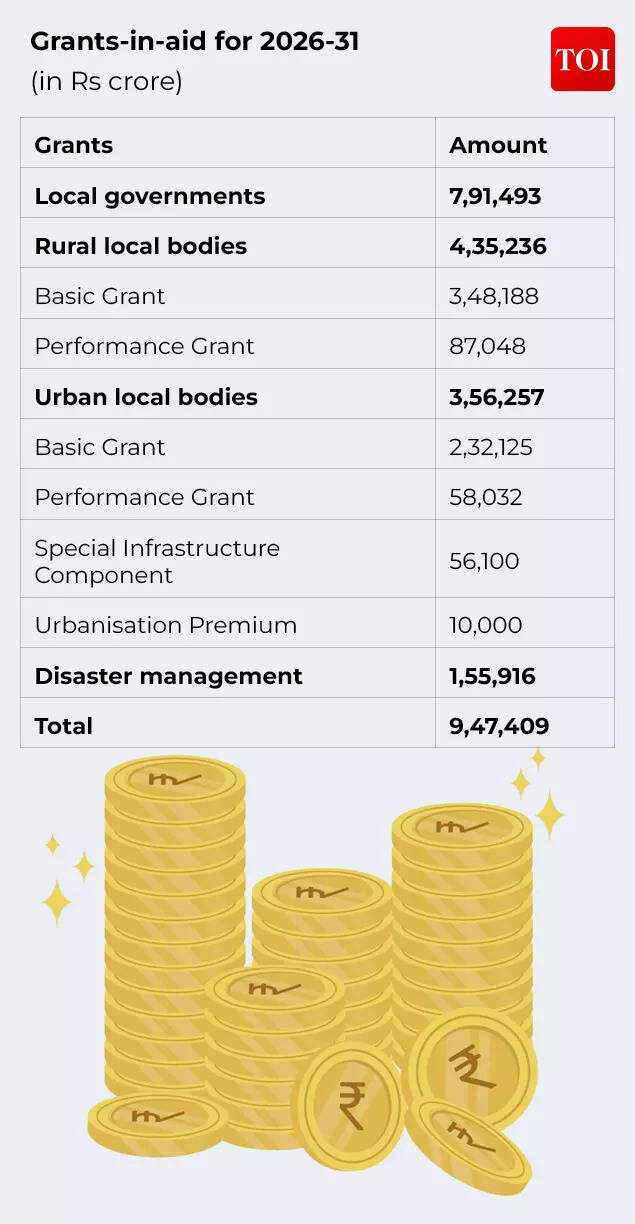
Of this, 80 percent is basic grant and 20 percent is performance linked.Performance conditions include publication of audited accounts, strengthening the property tax system and own revenue growth targets.Majumdar said transparency reform is fundamental.“Consistent reporting on the budget becomes the first step toward discipline,” he said.He said transparency alone without incentive design is insufficient.“The transition to uniform, on-budget accounting will ensure that states remain committed to the path of fiscal prudence. Transparency needs to be combined with targeted incentives for efficiency and progressive design,” he said.
disaster financing
The Commission has expanded formula-based disaster allocation using a disaster risk index based on hazard, risk and vulnerability.Banerjee said the framework tries to balance predictability with flexibility.“The recommendations of the Sixteenth Finance Commission regarding disaster relief and mitigation funds have brought fiscal flexibility,” he said.He said the scale of extreme disaster funding depends on the size of the incident.“The risk of extreme end disaster events, which essentially involves relief, has been adequately provided for with graded contributions from states and the Center depending on the size of the relief,” he said.He said accumulation of funds is controlled while allowing for emergency replenishment.“The Commission has also recommended capping the accumulation in the SDRF to the extent of the allocation for the last 3 years,” he said.“In case the fund gets exhausted due to any disaster, a provision has been made for its replenishment,” he said.He said utilization of mitigation expenditure remains low.“The challenge is the utilization of state disaster mitigation funds,” he said.“Working on mitigation measures using the Mitigation Fund would be the best way to reduce risks within the risk scenarios,” he said.Srivastava said tail-risk disasters remain the stabilization responsibility of the central government.“Tail-risk disasters refer to high-impact, low-probability events such as natural disasters and pandemics,” he said.


(Courtesy-Sandeep Adhwaryu)
“In the macro-fiscal stabilization framework, dealing with these disasters is largely the responsibility of the central government,” he said.He said fiscal rule flexibility may be necessary in extreme situations.“This requires some flexibility in the fiscal deficit for the GDP targets as provided in the Centre’s FRBM Act,” he said.He cited the example of the epidemic.“Even for events like COVID-19, it was the central government that increased its fiscal deficit to an extremely high level of 9.2% of GDP in 2020-21 to deal with the COVID-led economic contraction,” he said.He said the long-term destructive plan is incomplete.“There is also a case for planning in advance to deal with disasters like pandemics, nuclear and biological holocausts,” he said.Majumdar framed this change as building systemic resilience.“When the next black swan comes, the question is not whether the models predicted it, but whether financing can move at the pace needed,” she said.“By modernizing risk indices, expanding eligibility and introducing market-based risk transfer, the framework goes some way to ensuring that public finances maintain the agility needed for a new era of tail-risk volatility,” he said.
subsidy discipline
The Commission has recommended rationalization of subsidies, improved targeting, sunset clauses and stronger disclosures.Banerjee said the fiscal deficit ceiling already creates indirect discipline.“Fiscal federalism is a built-in mechanism in the structure that penalizes fiscal profligacy by states,” he said.“This is through limiting the fiscal deficit which means limiting what the state can borrow,” he said.He said that the pressure of adjustment falls on capital expenditure.“When states face serious financial constraints due to excessive subsidies, borrowing limits force them to rationalize expenditures,” he said.“Given the stringency of expenditure for salaries, pensions and interest payments, the disadvantage of such rationalization is capital expenditure,” he said.


representative image
He said that transparency can put pressure on the market.“Greater transparency on the fiscal position of a state will put downward pressure on the yields on state development loans raised by states, making borrowing more expensive,” he said.Srivastava said a stronger incentive structure could have been considered.“One possible approach could have been to more clearly exclude excessive or inappropriate subsidies in the assessment of states’ expenditure needs,” he said.“Designing calibrated fiscal incentives or disincentives linked to subsidy discipline can enhance accountability,” he said.
A Quiet Federal Makeover
The Commission does not abandon equality. Income gap remains the key driver.But incentive-based federalism now sits alongside support-based devolution.Growth versus redistribution, performance versus security and fiscal discipline versus political economy pressures now operate within the same transfer structure.Over the next five years, states will adjust spending, borrowing and welfare design around this framework.