

.jpg?w=3800&h=2000&w=150&resize=150,150&ssl=1 "NFL Pro Bowl Games 2026 rules and format for Skills Challenge and Flag Football
& more related news here")


zoe conwayNews reporter

 BBC
BBCThousands of people are living in homes that pose a risk to their health and safety after the “catastrophic failure” of two government insulation schemes, MPs have said.
Major flaws have been found in more than 30,000 homes that have had insulation installed through government schemes since 2022.
The Public Accounts Committee has now said the “level of non-compliance” by installers should be investigated for fraud and the government’s current response was “not credible”.
The Department for Energy Security and Net Zero said it was “blatantly false that there are widespread health and safety risks”.
A spokesperson said that “for the vast majority, this means a home may not be as energy efficient as it should be”.
The parliamentary committee, which monitors the effectiveness of government spending, said insulation schemes ECO 4 and GBIS, which start in 2022, were so badly designed that they were almost “destined to fail”.
It said they received “virtually no attention” from senior government officials, so they did not know whether the plans were working for at least two years.
Committee chairman Sir Geoffrey Clifton Browne said the level of non-compliance by insulation installers was so extreme that the case should be referred to the Serious Fraud Office.
The committee found that less than 10% of affected homes have been fixed since the problems emerged in October 2024.
It warns that when families have to wait for help, the potential for harm increases, resulting in “immediate health and safety risks that require immediate attention”.
The report also criticizes Trustmark, the organization that oversees the quality of insulation work, for not notifying higher level authorities of faulty external wall insulation by October 2024.
Responding to the committee’s report, Trustmark said it is “fully committed to ensuring strong consumer protection for all types of home improvements”.
“We are continuing to work with the government, our plan providers, registered businesses and, where appropriate, guarantee providers to address and fix these problems.
“These examples of poor quality workmanship are completely unacceptable and highlight the need for change and reform to the current system,” Trustmark said.
Affected customers can find information about Trustmark’s Find and Fix plan on their website.
Repair Cost
Government insulation schemes have been running for more than 15 years and have cost billions of pounds of public money. Their aim was to make homes warmer, reduce carbon emissions and help some of the poorest and most vulnerable people reduce their energy bills.
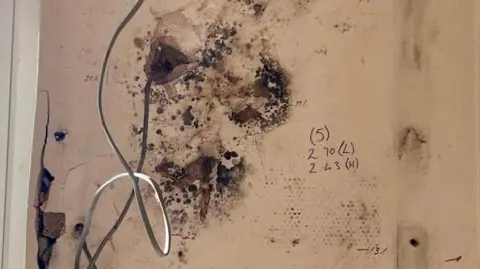
But BBC News reported on a number of cases last year where the work carried out was of such poor quality that it led to dampness, black mold and, in some cases, dry rot.
The government has said that the repairs of the houses will be done without any charge from the consumer.
It states that the original installer is responsible for fixing problems, and when an installer makes a malfunction or fails to adequately remedy the problem, the guarantee should cover repairs up to £20,000.
But the committee warned that repairs could cost more than this.
BBC News reported last year on the case of a house in Luton, where damage caused by a failure in external wall insulation was so extensive that it was estimated to have cost more than £250,000. The bill is being picked up by the installer’s insurer.
The Department for Energy Security and Net Zero said it expected only a small number of people would need the money to make their repairs.
But the Public Accounts Committee accused the department of underestimating the scale of the problem and said its plan was “not credible”.
The committee’s report focuses on actions to be taken after 2022, but BBC News has spoken to homeowners whose properties were untouched under earlier government schemes who say they also need help.
In October, the National Audit Office, which monitors government spending, said that between £56m and £165m worth of fraud could have been involved in the insulation schemes.
But MPs on the committee said they suspected the actual level of fraud was much higher.
Energy Consumer Minister Martin McCluskey said they were fixing a system inherited from the previous government which “was not fit for purpose and which had multiple points of failure”.
He said: “Under these two schemes every home that has external wall insulation installed is being audited, at no cost to the consumer.
“And we have made it clear that no family should be asked to pay money to make things right.
“Over 50% of all non-compliant properties found to date have been remedied.”
He said the government has decided to end the ECO scheme and is instead investing more through local authorities.


