




asilt carebusiness reporter

 BBC
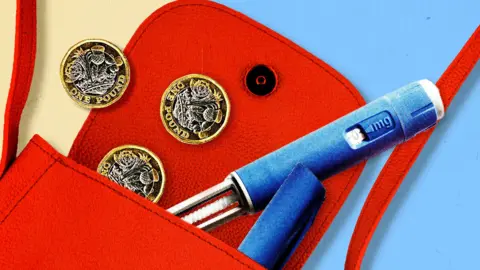
BBCThey’re injections that help some people lose weight, but weight loss drugs are also changing the way people spend.
The latest research from University College London shows that almost 1.6 million people in the UK will use weight loss jabs in 2024, with millions more saying they would be interested in trying them.
For those paying privately, they can cost more than £300 per month – but with their popularity only expected to grow, how are businesses adapting to a new type of consumer?
Buying Groceries: The Rise of More Nutrient-Dense Foods
 Sam Gilson
Weight loss injections work by mimicking a natural hormone, GLP-1, which regulates appetite, and people who use them have a decreased appetite.
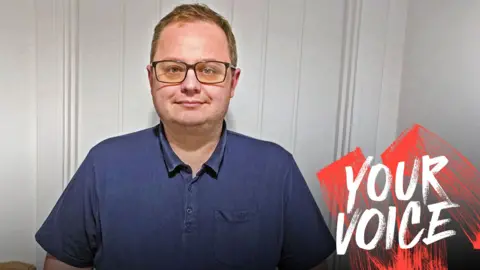
“My weekly food shop has practically stopped,” says Sam Gilson, 38, from Shropshire, who contacted BBC Your Voice. Since June he has lost more than four stone using weight loss jabs.
“I’m definitely buying more fresh food, and less unhealthy ready meals/easy dinner options like pizza, chips and nuggets.”
In the past few weeks, supermarkets The Co-op, Morrisons and Marks & Spencer have introduced nutrient-rich ranges of ready meals, and Ocado now sells 100g steaks, which it said was in response to the increasing number of customers wanting smaller portions.
Sam says eating less means he wants to make sure “you have all the nutrients and vitamins you need in small amounts”.
And it’s not just portion size. These are also types of foods.
Protein-rich products are appearing on shelves in the form of smoothies and snacks.
Jonny Forsyth, food and beverage strategist at consumer research group Mintel, says many of these trends are part of a broader shift in which health has become more important, especially for younger consumers.
He believes that GLP-1 drugs are “changing the culture”, making it fashionable to eat more nutrient-dense foods and “adding oxygen to existing trends”.
Eating out: ‘I used to go to restaurants once a week. Now I’m not
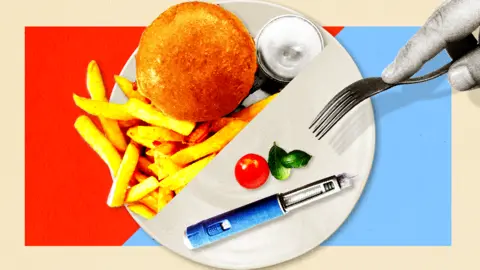
A survey last year by research consultancy KAM Insight found that about a third of people using GLP-1 drugs were going out less frequently to eat and drink.
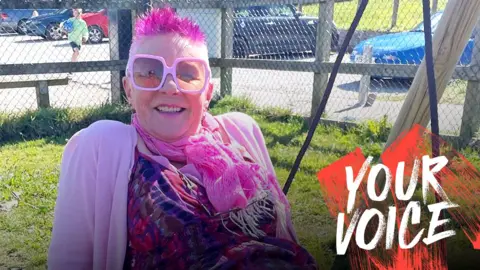
Annie Haslam, 70, from Cornwall has been using the weight loss injection since last March, and is currently spending around £186 a month on it.
“Instead of getting a takeaway once or twice a month, I haven’t had one for months,” she says. “I used to eat out in a restaurant maybe once a week, now I don’t do that.”
Sam also says he has cut down on the number of takeaways he gets, but adds that although he feels healthier, he isn’t really saving any money given the cost of the injections.
Earlier this month bakery chain boss Greggs said there was “no doubt” that weight loss drugs were driving people to seek “smaller portions”.
And it’s happening in fine dining too. The Fat Duck, the Michelin-starred restaurant in the Berkshires run by celebrity chef Heston Blumenthal, has introduced a new menu, which Blumenthal said is aimed at people who want to eat more “mindfully,” including those taking appetite suppressants.
Drinking: ‘A strong trend toward moderation’
There is also evidence that people taking weight loss medications drink less alcohol.
A study conducted in February 2025 by consumer research firm Worldpanel by Numerator found a 15 percent decline in alcohol volume purchases among households with GLP-1 users compared to a controlled benchmark.
Nicole Tallant, the Co-op’s food business director, told the BBC that supermarket members who take weight loss drugs are “reducing their food intake as well as their alcohol intake,” adding that “they are more concerned about overall health and overall well-being”.
Recent years have also seen an increase in non-alcoholic beverage options on shelves and in bars. The British Beer and Pub Association expects a record 200 million pints of low- and no-alcohol beer to be consumed in 2025.
“There’s already a very strong trend toward moderation,” says Mintel’s Jonny Forsyth.
“If I were an alcohol company, I would be a little concerned about this. GLP-1 drugs may further fuel that trend.”
Fashion: A wardrobe that no longer fits
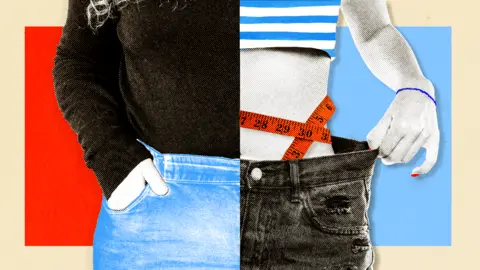
For Annie, one area she could not avoid spending on was clothing. After going from a size 18 to a size 12, she says her old clothes were “literally falling apart”.
He estimates it would probably cost him “a few thousand pounds” to replace everything, including underwear.
Dan Coatsworth, head of markets at AJ Bell, says that although no major fashion retailer on the stock market has talked explicitly about weight loss drugs in its financial results commentary, in his view, the direction of travel is clear.
He says the popularity of weight loss drugs will provide “a big tailwind (boost) for the fashion sector”.
While it’s unclear how this will present itself, Coatsworth believes second-hand platforms like Vinted, which are already popular, could see even greater growth, for people who very quickly find that their wardrobe no longer fits them.
 annie haslam
People who have lost weight too quickly may also gain a new sense of confidence and be inspired to “reinvent” themselves by wearing new clothes that they didn’t have before, says Simon Conu-Ray, a senior lecturer in fashion communication at Central Saint Martins, the University of the Arts in London.
“If you were a larger size, you probably wouldn’t feel like any of these trends or fashion outlets were speaking to you,” she says. “So you might be shopping in a completely different way.”
Beauty, health and fitness: More people are going to the gym
The desire for a new look is also being felt in the beauty and fitness sectors.
A survey by market research firm Worldpanel by Numerator last year suggested a boost in spending on health care, cosmetics and supplements among people taking weight-loss injections.
Some companies – in the US and now also in the UK – that offer wellness breaks are now advertising specific “retreats” targeting GLP-1 users.
Will Orr, chief executive of Gym Group, says demand for fitness services is increasing due to weight loss drugs as people taking them want to keep weight off and build muscle.
“We have begun educating our trainers about how to best support members on these treatments,” he says.
But he also notes a broader pattern of behavior that predates weight-loss drugs, calling health, fitness and wellness “juggernaut trends that aren’t going anywhere.”
This view is echoed by Georgia Stafford, research analyst in the beauty and personal care team at Mintel, who says that while GLP-1s are “certainly on the radar of most brands”, unlike the food industry, beauty brands have not yet launched products in the UK specifically for users of weight loss drugs.
“There have been some launches in the US, but they are very niche and very expensive,” she says, pointing out that the cost of weight-loss drugs may cause people to cut back on spending in other areas.
Instead, she says that many products promising thicker skin and thicker hair, often marketed as anti-aging, will already align with what weight-loss drugs might focus on.
Meanwhile, data from the British Association of Aesthetic Plastic Surgeons indicated there was an 8% increase in demand for facelifts in 2024, with the group’s chairman saying this was “an extension of the pattern we have always seen in post-weight loss patients” which is “now exacerbated by the widespread use of these drugs”.
Additional reporting by Emer Morrow and Chris Bramwell


