





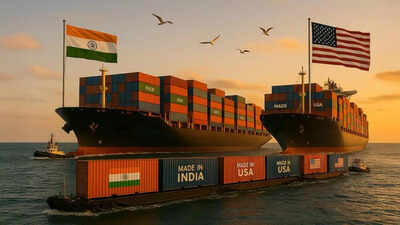
India and the United States have agreed to the framework of a bilateral trade agreement under which Washington will reduce tariffs on Indian goods to 18% from the current 50%.The announcement assumes significance as the US had imposed heavy duty on Indian exports entering the US markets from August 27, 2025.
In August 2025, Washington announced 25% tariffs with an additional 25% punitive duty on India for purchases of Russian crude oil and military equipment. These duties were imposed on top of existing tariffs on Indian goods. Under the new structure, the total duty has now been reduced to 18%.Prime Minister Narendra Modi welcomed the move, saying he was happy that “products made in India will now have a lower tariff of 18%.”Tariffs are customs duties or import duties imposed by one country on goods purchased from other countries.
How does India compare globally?
A comparison of US tariff rates across major economies places India in the middle of the global tariff spectrum, with its exports facing a duty of 18%.Brazil faces the steepest tariffs at 50%, followed by Myanmar and Laos at 40% each. China faces a 37% tariff, while South Africa faces a 30% duty.Many manufacturing hubs in Southeast Asia are subject to tariffs in the 19–20% range, including Vietnam and Bangladesh at 20%, and Malaysia, Cambodia and Thailand at 19% each.With an 18% tariff, India is now below most emerging market competitors, giving it a relative pricing advantage in the US market.Advanced economies enjoy significantly lower tariffs. The European Union, Switzerland, Japan and South Korea each impose a 15% duty, while the United Kingdom has the lowest rate at 10%.The tariff cuts are expected to benefit India’s labour-intensive sectors, as exporters will be able to price their products more competitively in the US market.
Why did America impose tariffs?
The US has argued that it faces a significant trade deficit with India, blaming New Delhi for imposing high tariffs on US goods, which it says restricts US exports to the Indian market.Under the proposed agreement, India is expected to immediately eliminate duties on some goods, phase out duties on others, reduce tariffs in certain sectors and grant quota-based tariff concessions for select products.However, sensitive sectors like agriculture and dairy are completely out of the scope of the agreement, PTI reported.An executive order from the US is expected to provide more clarity on the tariff changes, while a joint statement from the two countries will outline the areas covered under the deal. Waiting for both.


