


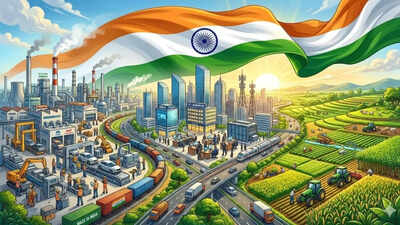
 The United Nations Economic and Social Commission for Asia and the Pacific (ESCAP) in its latest Economic and Social Survey of Asia and the Pacific 2026 said the region’s economies grew by 5.4 per cent in 2025, up from 5.2 per cent in 2024, mainly supported by India’s strong performance.According to news agency PTI, the report said India’s growth rate is projected to rise to 7.4 per cent in 2025, supported by “strong consumption, particularly the rural economy, as well as goods and services tax rate cuts and export frontloading ahead of United States tariffs.”
Growth slowed down amid global headwinds
The report noted that economic activity in India slowed down in the latter half of 2025, mainly due to a sharp 25 per cent decline in exports to the United States after Washington imposed 50 per cent tariffs in August last year. Despite this, the services sector remained a major growth engine.Inflation is expected to remain relatively stable, at 4.4 percent in 2026 and 4.3 percent in 2027, indicating stable expansion as well as a controlled price environment.
FDI, remittances and external pressure
ESCAP highlighted that foreign direct investment (FDI) flows into developing Asia-Pacific economies are projected to decline by 2 percent in 2025 amid trade tensions and geopolitical uncertainty, even as global FDI flows increase. However, India remained one of the top destinations for greenfield investments, attracting nearly $50 billion in the first three quarters of the year.The report also points to the importance of remittances in maintaining domestic consumption. India, the world’s largest remittance recipient with $137 billion in 2024, may face challenges after the United States imposed a 1 percent tax on such transfers from January 2026.
Green transition and job creation
ESCAP emphasized the role of the clean energy transition in shaping future development. It cites estimates showing 16.6 million green jobs globally, of which India’s share is about 1.3 million. Policies such as India’s production-linked incentive scheme were highlighted as key tools to boost domestic manufacturing in sectors such as solar energy, batteries and green hydrogen.“Governments can take advantage of the energy transition to promote new domestic industries,” the report said, stressing the importance of targeted industrial policies.The UN’s outlook is broadly in line with recent projections by the International Monetary Fund, which also expects India to remain the world’s fastest-growing major economy. However, global risks remain, particularly from ongoing geopolitical tensions and trade disruptions.Despite these uncertainties, the UN report shows that India’s economic fundamentals remain strong, supported by strong domestic demand, policy support and its growing role in global supply chains.


