


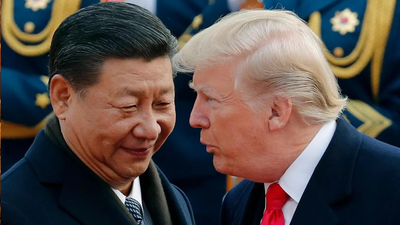
The last meeting between US President Donald Trump and Chinese President Xi Jinping ended on a positive note. Trump gave the summit a “12 out of 10” rating, and the White House said China would “effectively end” rare earth export controls and stop retaliating against American companies.However, recent developments suggest that Beijing has changed its approach.Even as China has avoided openly criticizing Trump over the Iran conflict and signaled interest in constructive engagement ahead of another proposed summit, it has parallelly moved to expand its economic influence against Washington.
Beijing’s ‘rare’ step
A series of steps initiated since the October meeting highlight this change. Beijing has tightened licensing rules for rare earth exports, introduced laws targeting companies that shift supply chains out of China, and blocked the use of foreign AI chips in state-funded data centers. It has also banned Chinese companies from using some American and Israeli cybersecurity software and is considering restricting exports of advanced solar manufacturing equipment to the United States.Analysts say the moves go beyond routine retaliation and instead point to a broader strategy. China appears to be rolling out a more structured set of economic pressure tools, long aligned with US policy, at a time when both sides are operating under a temporary trade truce. The agreement, which runs through November 2026, was partly shaped by China’s earlier threat to curb rare earth exports, which immediately disrupted U.S. auto supply chains and brought Washington to the negotiating table in Busan, South Korea.“The hope on the Chinese side is for a longer-lasting, more broadly contained ceasefire, but this is very much a ‘if you want peace, be prepared for war’ argument,” Joe Mazur of Trivium China told Reuters.China has since continued to refine its options.In April, Premier Li Qiang approved two new regulations giving authorities sweeping powers to take action against foreign entities accused of discriminating against China’s industrial system or exercising what Beijing calls “unreasonable extraterritorial jurisdiction.” These rules allow authorities to deny entry, expel individuals, and seize property if violations are found.
Rising stress and ripple effects
This time also reflects broader geopolitical tensions. When US Treasury Secretary Scott Besant warned in mid-April of possible sanctions on buyers of Iranian oil, much of which is bought by China, the reaction from Beijing-linked voices was swift. Yuyuan Tantian, with state broadcaster China Central Television, described the new framework as part of a broader set of legal countermeasures, saying: “In the past, our countermeasures were largely focused on the trade sector. “But today’s international conflict is broader, and those tools are no longer sufficient.”Business groups have expressed concerns about the immediate implementation of these rules. Michael Hart of the American Chamber of Commerce in China said the companies were given no opportunity to respond. “Companies now face an asymmetry: China can reduce purchases from foreign companies without any consequences, while a foreign company that reduces its dependence on China risks investigation,” he said.At the same time, the United States has maintained its pressure. It launched fresh trade investigations into China’s industrial capacity and labor practices in March, while maintaining export restrictions on semiconductor and chipmaking technology that have hampered China’s ability to produce advanced chips.“It is because of export controls that China does not have access to some of the world’s most advanced semiconductor manufacturing equipment,” said Chim Lee of the Economist Intelligence Unit.This competition for leverage has also spilled over into commercial negotiations, including discussions on large aircraft purchases from Boeing. While China is seeking aircraft and spare parts, U.S. officials have made progress in supplying yttrium, a rare earth element needed for jet engine production.China, for its part, has strengthened its domestic requirements. From the end of 2025, chipmakers are required to source at least half of new equipment locally. At the same time, foreign AI chips are being phased out of state-backed data centers, and restrictions on foreign cybersecurity tools have been tightened, steps that encourage domestic alternatives while limiting access for U.S. suppliers.Concerns are growing about broader implications. The European Chamber of Commerce in China has warned that China’s evolving export control framework could “disrupt global supply chains on an unprecedented scale, causing both economic and non-economic damage.”As Washington works to reduce its dependence on Chinese critical materials, Beijing is actively identifying new pressure points. Preliminary discussions have already taken place with solar equipment manufacturers about restricting exports of cutting-edge technology to the US.

