


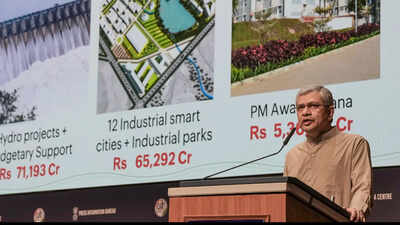
The Union Cabinet on Friday approved a Rs 1,264 crore railway project to add the third and fourth rail lines on the Ballari-Guntakal section in Karnataka and Andhra Pradesh, aimed at decongesting, improving freight movement and strengthening connectivity along a key economic corridor.The project was approved by the Cabinet Committee on Economic Affairs (CCEA) chaired by Prime Minister Narendra Modi, and is part of the PM Gati Shakti National Master Plan to enhance multimodal connectivity and logistics efficiency.Announcing the decision, Union Railway Minister Ashwini Vaishnav said the Ballari-Guntakal section is an important economic corridor connecting Andhra Pradesh and Karnataka.The cabinet has taken two big decisions. First, the third and fourth lines have been approved on the Ballari-Guntakal rail section, which falls on the important economic corridor between Andhra Pradesh and Karnataka. This project will be done with an investment of Rs 1,264 crore,” Vaishnav said.He said that the detailed project report (DPR) for the proposed Hospet-Hubli railway line is also being prepared.
Project to add 46 km to rail network
The multi-tracking project will extend the Indian Railways network by approximately 46 kilometers and is scheduled to be completed by 2028-29.The project spans three districts of Karnataka and Andhra Pradesh and is expected to improve connectivity for about 99 villages with a combined population of about seven lakh.The government said the additional rail capacity will facilitate smooth movement of passengers as well as goods through an integrated scheme under the PM Gati Shakti framework.
Goods transportation and tourism will get a boost
According to the government, the Ballari-Guntakal route is a major freight corridor used to transport commodities such as iron ore, dolomite, limestone, iron and steel, coal, fertilizers and food grains.The capacity expansion is expected to generate additional freight traffic of 16.22 million tonnes per annum (MTPA).The project is also expected to improve rail access to tourist destinations including Ballari Fort and Sri Kumar Swamy Temple.
Lower logistics costs, lower emissions
The government said the project will improve operational efficiency and service reliability while helping to reduce congestion on the existing route.The increased rail capacity is also expected to contribute to India’s climate goals by reducing dependence on road transport. It is estimated that this project will save 1.32 crore liters of oil and reduce 6.67 crore kg carbon dioxide emissions, which is equivalent to planting 0.27 crore trees.“The increased line capacity will significantly increase mobility, resulting in improved operational efficiency and service reliability for Indian Railways. This multi-tracking proposal is set to streamline operations and reduce congestion,” the government said.It said the project is in line with Prime Minister Narendra Modi’s vision of ‘Self-reliant India’ by promoting regional development and creating more employment and self-employment opportunities.


