


what is the story
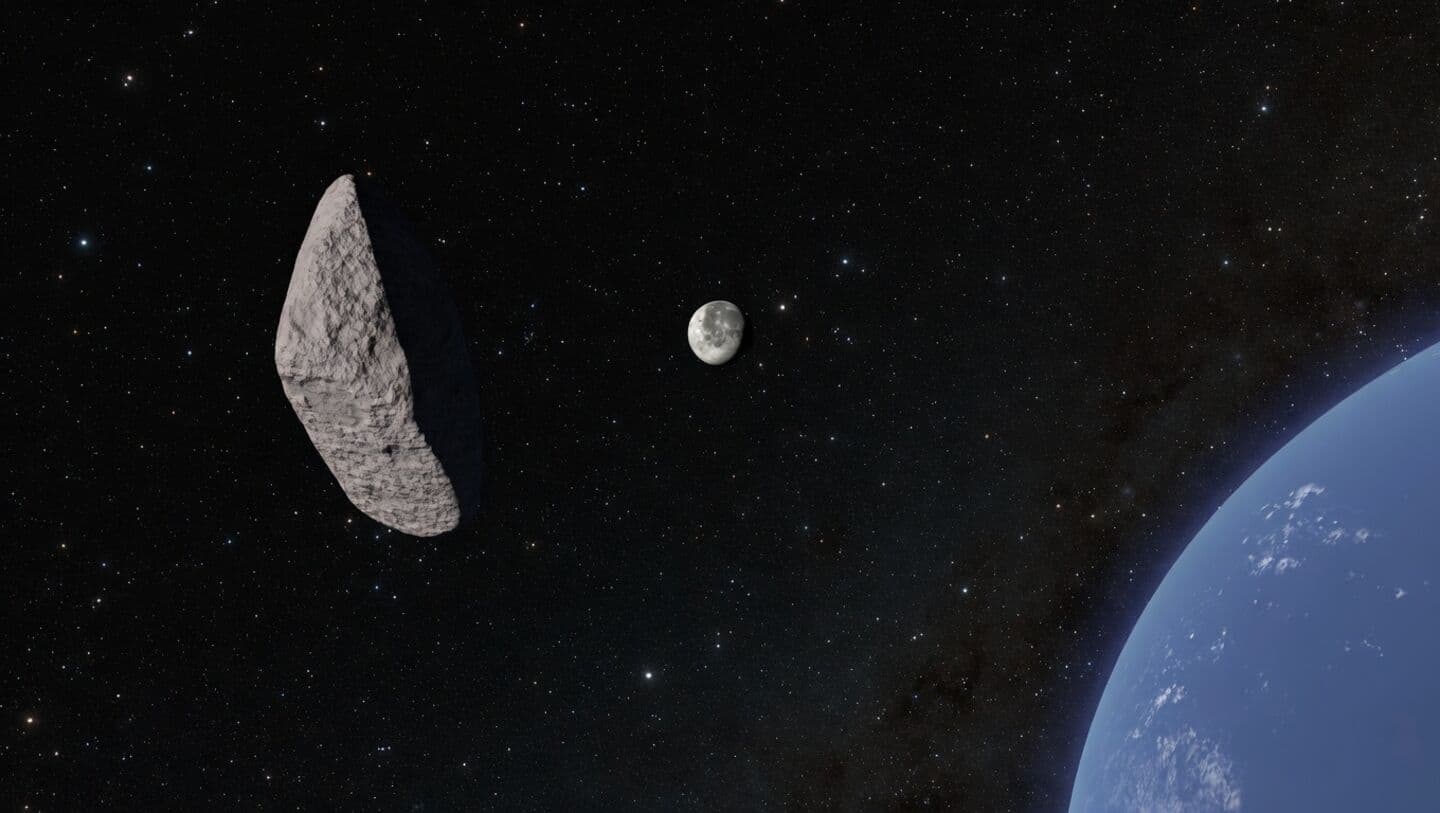
The James Webb Space Telescope has confirmed that asteroid 2024 YR4 will not collide with the Moon in 2032. The celestial body, which was previously thought to have a 4.3% chance of hitting our lunar companion, will instead pass safely at an altitude of more than 21,000 km. Researchers at the Johns Hopkins University Applied Physics Laboratory (JHUAPL) organized observations of JWST and worked with several teams to refine the orbit and rule out a lunar impact.
Initial predictions indicated a possible impact on Earth.
Discovered on December 27, 2024 by the NASA-funded Asteroid Terrestrial Impact Latest Alert System (ATLAS), asteroid 2024 YR4 was initially considered a potential threat. With a diameter of about 60 m, it posed the risk of impacting Earth on December 22, 2032. Such an event could have destroyed a city or caused catastrophic tsunamis if it had hit the ocean.
Uncertainty about the lunar impact
While it was confirmed that asteroid 2024 YR4 would miss Earth, its possible lunar impact remained uncertain. This was due to a lack of precise knowledge about its orbit around the Sun. However, between 18 and 26 February this year, JHUAPL researchers took the opportunity for the James Webb Space Telescope (JWST) to observe asteroid 2024 YR4 against a faint field of stars whose positions have been precisely measured by ESA’s Gaia mission.
JWST tracks asteroid’s movement against stars
JWST tracked the movement of asteroid 2024 YR4 against the stars, refining its orbit with high precision. Despite being one of the faintest targets ever observed by JWST, it was no easy task because the telescope’s near-infrared camera has a field of view of only 2.2 square arcminutes. The successful follow-up was a joint effort between JHUAPL scientists, space telescope engineers, the European Space Agency’s Near-Earth Object Coordination Center and NASA’s Near-Earth Object Studies Center.
Asteroid will safely pass at an altitude of more than 21,000 kilometers
The new JWST measurements rule out a collision with the Moon. Instead, asteroid 2024 YR4 will pass more than 21,000 kilometers above the lunar surface. This is still a close encounter, but it does not pose any danger to our planet or its natural satellite. Had it hit the near side of the Moon, scientists would have witnessed their first close-up look at a massive impact and Earthlings would have seen a bright flash and a new crater about 1 kilometer in diameter.


