



Globally, technology sector stocks are leading the stock market rallies. The picture is opposite in India. The Nifty IT index has fallen about 23% since the beginning of the year, much slower than the broader market’s decline of about 10%. In fact, IT has been the worst performing key sector in the Indian market over the last 12-18 months. In May, 2026, the Nifty IT index hit a nearly 3-year low, and its value declined by more than a quarter since the beginning of the year.Analysts say IT has not only underperformed better-performing sectors like metals and pharma, but also performed worse than most other declining sectors, indicating sector-specific deterioration rather than a broader market recovery.Quarterly earnings and future guidance have disappointed, with HCLTech guiding only 1-4% revenue growth in FY27, Infosys guiding 1.5-3.5%, and Wipro guiding Q1 FY27 to be flat by -2%. What is the reason for Indian IT sector stocks going into the red? Have IT stocks, once the darling of Dalal Street, lost their luster? And what should investors do?
Why are IT sector shares falling so much?
The answer is in two words: Investors are growing concerned about artificial intelligence, AI disruption. Whenever a major AI company, be it OpenAI, Anthropic, or others, launches a new product or announces deep enterprise incentives, IT stocks fall! Manav Medewala, Research Analyst, Mirae Asset Sharekhan explains:
- The sharp decline in Nifty IT can be mainly attributed to rising AI disruption concerns, where ‘AI deflation’ is expected to compress pricing and automate parts of traditional services, including advanced models like cloud.
- At the same time, companies are facing cautious discretionary spending from clients, especially in global markets, leading to slower deal conversion and revenue growth.
- Add to this customer-specific issues, tariff uncertainties and broader macro headwinds, which have put further pressure on sentiment.
- In short, the recovery reflects a mix of structural disruption and near-term demand weakness rather than a complete erosion of the sector’s long-term potential.
Shashwat Singh, Fundamental Analyst- Bajaj Broking says most companies are guiding for low single-digit constant currency growth, reflecting continued caution in discretionary IT spending. Demand is increasingly leaning towards AI-led transformation, productivity programs and vendor consolidation, while traditional discretionary digital spending remains low. He told TOI that currently, the sector is in a relatively developed stage, especially with regard to adoption and monetization of AI capabilities.He further added, “Most companies are still in the early stages of developing AI-based offerings, and a clearly differentiated strategy across the sector has yet to fully emerge. Given the current macroeconomic uncertainties and limited near-term visibility on global technology spending, the IT sector remains in a cautious stance.”
Record buyback is being seen in IT sector
Amidst all this, Indian IT companies have returned record amount of money. With Rs 1.3 lakh crore going to shareholders in FY26 through dividends and buybacks, nearly 36% more than the previous year, the combined payout ratio crossed 100% of net profit. Earlier Infosys had done buyback of Rs 18,000 crore and now Wipro has announced a new buyback of Rs 15,000 crore. What does this mean?On the surface, this is good for shareholders as it provides a cash return cushion even if the stock price remains weak, according to Sushovan Nayak, Lead IT Research Analyst, Anand Rathi Institutional Equities. “However, high payout ratios above 100% mean that these companies are not finding enough high-return investment opportunities to deploy all their cash internally. However, this reflects the capital-light nature of the IT services business model. For now, we view the higher payout as a sensible move to support shareholder returns during a period of slow growth,” he tells TOI.Shashwat Singh, fundamental analyst at Bajaj Broking, points out that historically, Indian IT companies have been strong cash generators, consistently using surplus reserves to reward shareholders through buybacks and dividends.

“While we expect a continued commitment to shareholder returns, companies can take advantage of this opportunity to invest in building stronger AI capabilities through organic and targeted inorganic opportunities,” he told TOI.According to Manav Madewala, research analyst at Mirae Asset Sharekhan, the increase in buybacks and dividends essentially reflects that IT companies are sitting on strong cash flows but are facing slowing growth in the near term, so they are returning excess capital to shareholders rather than aggressively reinvesting it. They also believe it is a way to support stock prices and signal confidence during the regional recovery phase. This trend is also global, with Cognizant increasing its 2026 buyback target to $2 billion, underscoring similar dynamics of cash strength and devaluation. Simply put, the sector today is rewarding shareholders while restructuring for an AI-driven future, making this more of a transition phase than a structural recession, he says.
Has the shine of the IT sector faded?
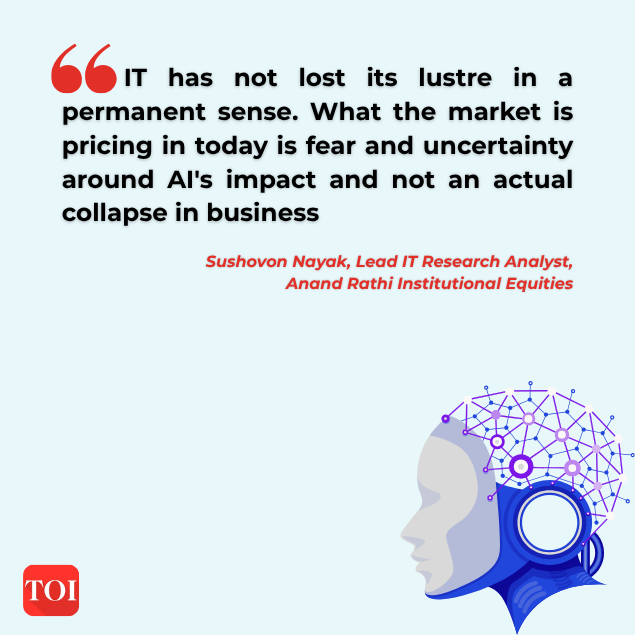
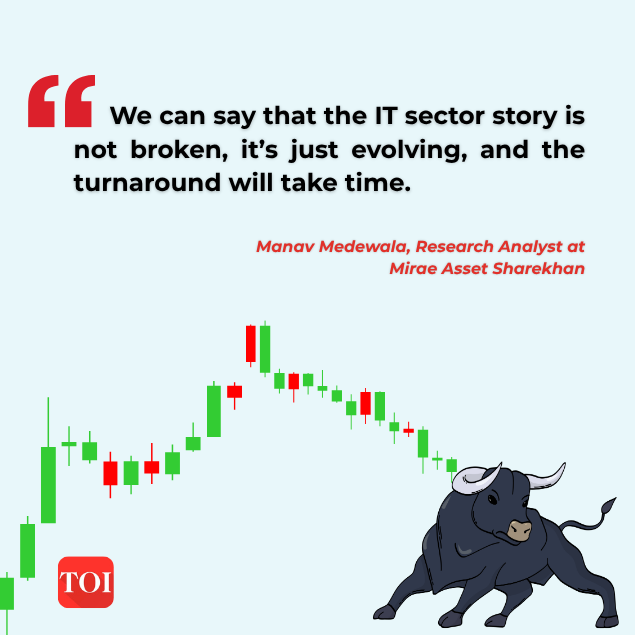
Are investors overreacting to the impact of AI on the IT sector? Analysts TOI spoke to expressed confidence in the IT sector, adding that they expect the sector to adapt to the ongoing disruptions caused by artificial intelligence.Manav Madewala of Mirae Asset believes that while IT sector stocks have not lost their luster, it is undergoing a necessary reset. “History shows that every major technology shift takes time for companies to adapt, pivot, and rebuild growth engines, and AI is no different. Right now, the sector is in a transition phase in which short-term disruption, slower spending and changes in business models are impacting performance. But long-term demand for AI, cloud and digital services remains. In simple words we can say that the story is not broken, it is simply evolving, and change will take time,” he told TOI.Sushovan Nayak, principal IT research analyst, Anand Rathi Institutional Equities does not see any lasting damage to the IT growth story.“What the market is pricing in today is the fear and uncertainty around the impact of AI, not the actual decline in business. IT companies are still profitable, generating strong free cash flows, winning big deals and paying record dividends. The market is grappling with the question of whether AI will become a growth multiplier or a deflationary force for Indian IT,” Nayak told TOI.“In our view, this will likely happen over time, but the net impact for scaled IT players will be positive in the medium to long term as they become the integration and deployment layer for enterprise AI adoption globally,” he added.
For Antu Eapen Thomas, Senior Research Analyst, Geojit Investments Ltd., the medium to long-term outlook remains intact, supported by strong client relationships, deep expertise in regulated sectors and legacy modernization opportunities. Thomas says maintaining this position will require continued investment in proprietary AI capabilities to drive efficiency and drive business transformation.
What should investors do with IT stocks?
Market experts say churn caused by AI is likely to continue to be a near-term risk for IT sector stocks. Although he believes the long-term story remains intact, the current decline in stock prices provides an opportunity for investors with a medium to long-term horizon to accumulate some IT stocks.Manav Medewala advises that from a portfolio perspective, this is not the stage to exit IT stocks; It’s a hook and slowly builds up the story. “In the short term, expect volatility due to weak demand and AI-led uncertainty, so returns may remain low. It is better for existing investors to hold positions, as the sharp correction has already priced in a large portion of the near-term concerns, while new investors may look at gradual accumulation rather than outright buying to deal with the volatility,” he advises.He further added, “From a stock perspective, investors should remain selective rather than adopting a broad-based sector approach, focusing on large caps like Infosys and Tech Mahindra for sustainability, while keeping an eye on mid-tier names like Persistent Systems and Coforge for growth opportunities.”Sushovon Nayak of Anand Rathi Institutional Equities sees near-term pressure in stocks, though he advocates entry for investors with a 2-3 year horizon. “The structural demand story for Indian IT remains intact – driven by enterprise digital transformation, cloud migration, data modernization and now AI deployment. As AI moves from proof-of-concept to full-scale production, Indian IT companies are well-positioned to emerge as the integration and deployment layer of choice,” he says.“Our suggestion to investors would be to accumulate selectively. Within large-caps, we like Infosys, TechM and LTIM for their scale, deal pipeline and AI readiness. In mid-caps, names like Persistent and Mphasis offer strong niche positioning and growth. Investors should avoid trying to hit the exact bottom and instead moderate their buying during the correction.”(Disclaimer: The recommendations and views given by experts on the stock market, other asset classes or personal finance management tips are their own. These opinions do not represent the views of The Times of India.)