


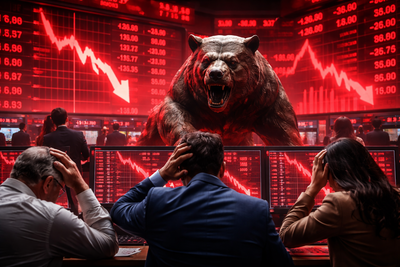
Global markets have been on a roller coaster ride recently, jolted by the ongoing conflict in the Middle East, which has now entered its fourth week. By Thursday, they had wiped out Rs 12.87 lakh crore from investors’ wealth in a sharp selloff as there was bloodshed on Dalal Street. Going further back, ever since the crisis in this sector emerged, till March 19, investors have suffered a loss of more than Rs 37 lakh crore.As the index fluctuates, investors stare at the red screen wondering whether to take action or sit back. The big question is what should you do? Act now, or wait for that golden opportunity. But amid the noise, a familiar reminder is lingering: Market moves can be sharp in the short term, but reacting too quickly can often cause more harm than good. Speaking on volatility in global markets, Harish K Ahuja, Head of Sustainability, Power and Carbon Markets, Listings and Social Stock Exchange at the National Stock Exchange of India (NSE), has called on retail investors to remain stable and avoid reacting to short-term market fluctuations.Commenting on recent trends, Ahuja said that the improvement being seen is not limited to India alone but is part of a broader global movement. “Most exchanges around the world are seeing 7% to 10% corrections. And that’s just a part of the up and down market,” he said.He cautioned retail participants against panic-driven decisions during the period of uncertainty. “My suggestion to retail investors: Don’t panic. Be patient, you are an investor, not a trader,” he said.According to Ahuja, India’s economic fundamentals remain supportive despite external pressures. “My understanding of the Indian market is, India is growing. Indian fundamentals are very positive in terms of GDP growth, inflation, most of the indicators, be it industrial growth, power consumption,” he said.He also highlighted the strength and scale of India’s capital markets, pointing to strong participation levels and activity. “India has had the highest number of IPOs in the world. We are one of the largest exchanges in terms of number of unique investors and unique accounts,” he said.Ahuja highlighted that investing should be viewed from a long-term perspective rather than a daily trading mindset. “Investing means, to me, the definition of investing is that once you buy a stock, at least for the next five to ten years, don’t look at the stock on a daily basis,” he said.Reiterating his view, he said patience and understanding of macroeconomic fundamentals are important to deal with volatility. “I think I am always positive about the market because I am a patient investor. Once you are patient, once you understand the fundamentals of the economy and the country as a whole, you should not panic.”He further indicated that investors who maintain discipline and focus on the long-term horizon are more likely to weather short-term geopolitical disruptions and benefit from market growth over time.


