


Amid the ongoing debate over E20 petrol, the government on Monday said there is no confirmed evidence linking ethanol-blended petrol (E20) to widespread engine failures or vehicle breakdowns, pointing to both scientific studies and on-road experience of over 23 crore vehicles across India.Responding to a question in the Rajya Sabha, Minister of State for Petroleum and Natural Gas Suresh Gopi said, “More than 20 crore two-wheelers and more than 3 crore petrol cars, including a large number of older vehicles manufactured before E20 certification, are running on these fuels without any verified evidence of widespread engine failure or vehicle breakdown due to ethanol blending.”He further said the shift to E20 fuel has been “phased, calibrated and evidence-based”, noting that the ethanol blending rate was gradually increased from 1.53 per cent in 2013-14 to 20 per cent in 2025-26 after “scientific assessment and stakeholder consultation at every stage”.In its written reply, the government said every increase in ethanol blending was preceded by a detailed study conducted in consultation with NITI Aayog, Automotive Research Association of India (ARAI), Society of Indian Automobile Manufacturers (SIAM), Indian Institute of Petroleum (IIP), oil marketing companies and automobile manufacturers.

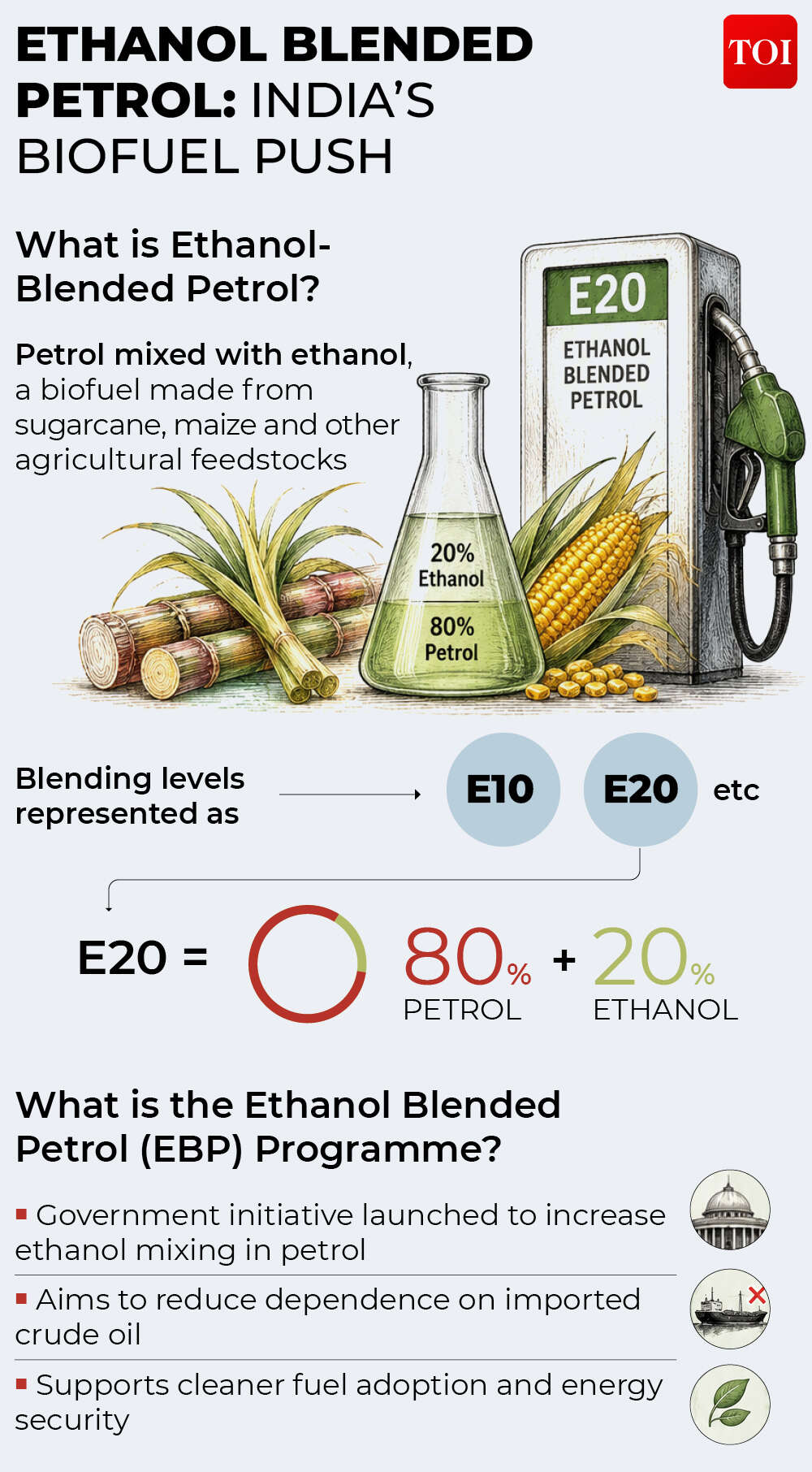
What is the Ethanol Blended Petrol Program?
The evaluation process included laboratory testing, durability evaluation and field tests examining engine durability, fuel system, corrosion resistance, handling capability, emissions, fuel efficiency and overall vehicle performance.The minister said that service records maintained by vehicle manufacturers further strengthen these findings. “A leading four-wheeler manufacturer serviced 2.84 crore vehicles during FY 2025-26, including 1.5 crore older, non-E20-certified vehicles, without reporting any vehicle damage due to E20 fuel.” Similarly, “A leading two-wheeler manufacturer reported, based on extensive service data, that there is no higher incidence of damage in vehicles running on E20 compared to earlier fuel blends.“Addressing concerns over fuel economy, the government said mileage is affected by many factors, including driving conditions, driving behavior and vehicle maintenance. It states that “Any reduction in fuel economy in some older E10-designed vehicles is generally limited to about 3-5%, while E20 offers a higher octane rating, better anti-knock characteristics, cleaner combustion and smoother engine operation.“The minister also told the Rajya Sabha that at present there is no decision to increase the ethanol blending beyond 20 percent. “Any future decision regarding higher ethanol blends will be taken only after detailed scientific and technical studies and consultation with all relevant stakeholders including automobile manufacturers, oil marketing companies and research institutions,” the reply said.The government also clarified that “there is no proposal to mandate the availability of non-blended or low-blended petrol at selected retail outlets,” adding that its policy continues to focus on a gradual transition to cleaner and more sustainable fuels under the Ethanol Blended Petrol Programme.