


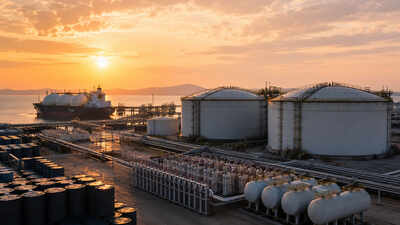
India’s energy security has received special attention since the beginning of the US–Iran conflict. The need for strong strategic reserves to counter the impact of global supply disruptions cannot be overstated.India’s dedicated strategic petroleum reserves capacity is 5.33 MMT, spread across Visakhapatnam, Mangaluru and Padur, which is equivalent to about 9.5 days of crude oil consumption in March 2026 as per PIB data released. Government has approved Phase II expansion of 6.5 MMT at Chandikhol (Odisha) and Padur (Karnataka) under PPP model.Once completed, the total strategic petroleum reserves capacity will increase to 11.88 MMT, taking India much closer to the 90-day reserve target.
cjp jantar mantar protest update
India is working with the UAE for 30 million barrels of crude oil storage capacity. But, importantly, experts say India’s strategic petroleum reserve policy should evolve into a comprehensive energy security strategy that includes crude oil, LPG and LNG.

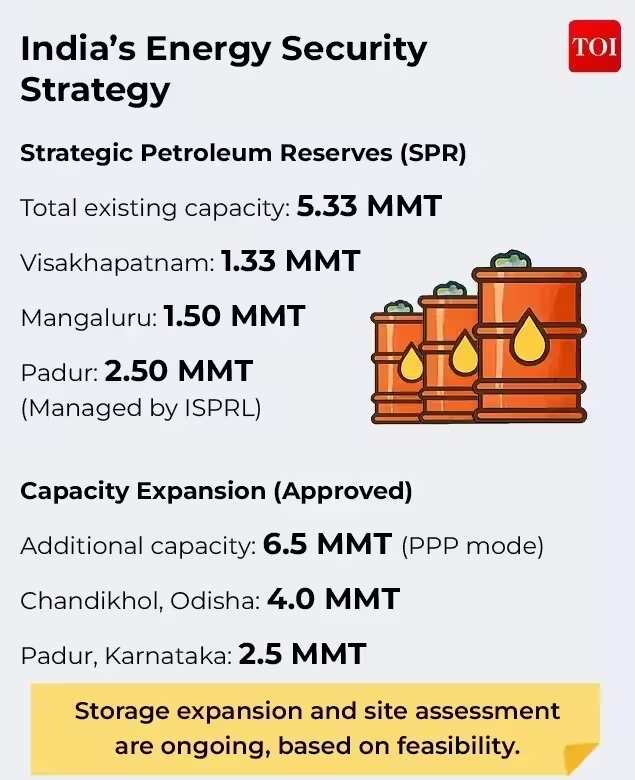
India’s Energy Security Strategy
Pranab Master, director of CRISIL Intelligence, advocates a three-tier strategic reserves policy: large physical reserves for crude, distributed operational-safety reserves for LPG, and primarily contractual or virtual reserve models for LNG, as LNG is expensive and technically difficult to store for long periods.What should India’s immediate and long-term energy security plans look like? We decode:
Focus on strategic petroleum reserves
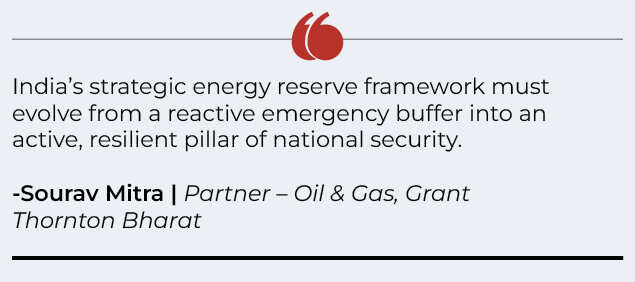
Experts advocate a proactive approach to maintaining strategic reserves keeping in mind the long-term to medium and immediate objectives.Saurav Mitra, Partner – Oil & Gas, Grant Thornton India says that for crude oil, India should aim for at least 30 days of dedicated strategic reserves managed by the Indian Strategic Petroleum Reserve Limited (ISPRL).This must be complemented by a mandatory 60 days of commercial refiner operating stock. Mitra told TOI that this would take the total national coverage to about 90 days, which is in line with the standards set by agencies like the International Energy Agency (IEA).

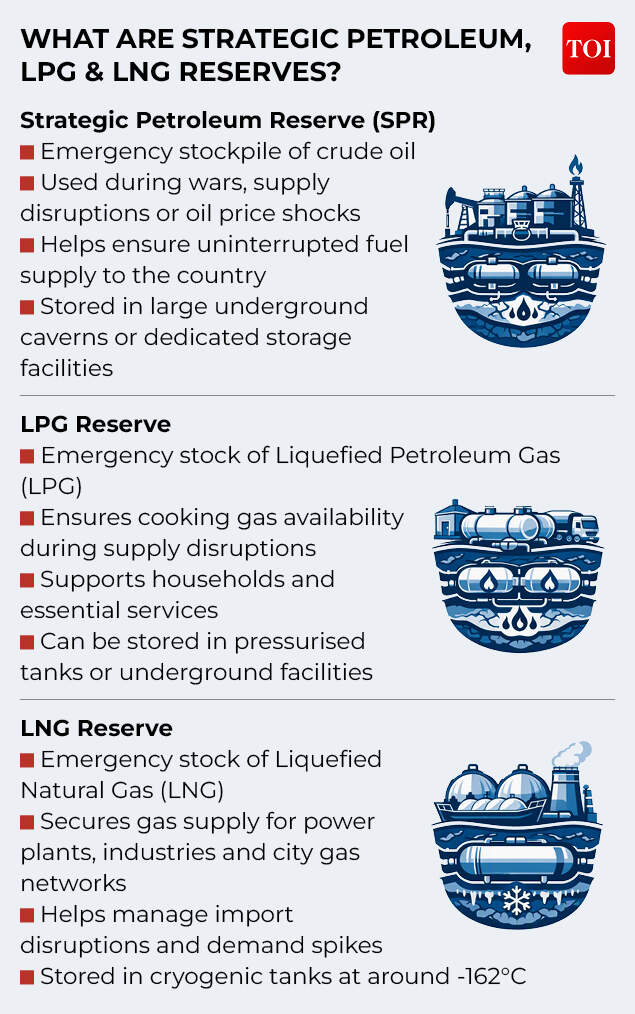
What are Strategic Petroleum, LPG and LNG Reserves?
Sumit Ritolia, principal analyst, modeling and refining at Kepler, also advocated 75-100 days of total inventory cover, in line with international best practices.“Given the country’s growing refining capacity and dependence on imports, expansion of strategic crude oil storage should remain a top priority,” he says.According to Pranab Master, the crude reserve policy should include the following key elements:
- Minimum stockholding requirement, so that storage capacity is not underutilized.
- A transparent drawdown and release framework with clearly defined triggers such as geopolitical conflicts, sanctions, shipping disruptions, extreme price shocks or major supply outages
- A counter-cyclical inventory build-up mechanism that encourages reserve accumulation during periods of low global oil prices rather than relying on emergency purchases during a crisis.
lpg stock
LPG fuel availability affects more than 330 million households and hence disruption in LPG supply immediately becomes a household welfare issue and can create social tension. India imports about 60% of its LPG requirement, and a large part of that import is linked to the Gulf region and the Strait of Hormuz.

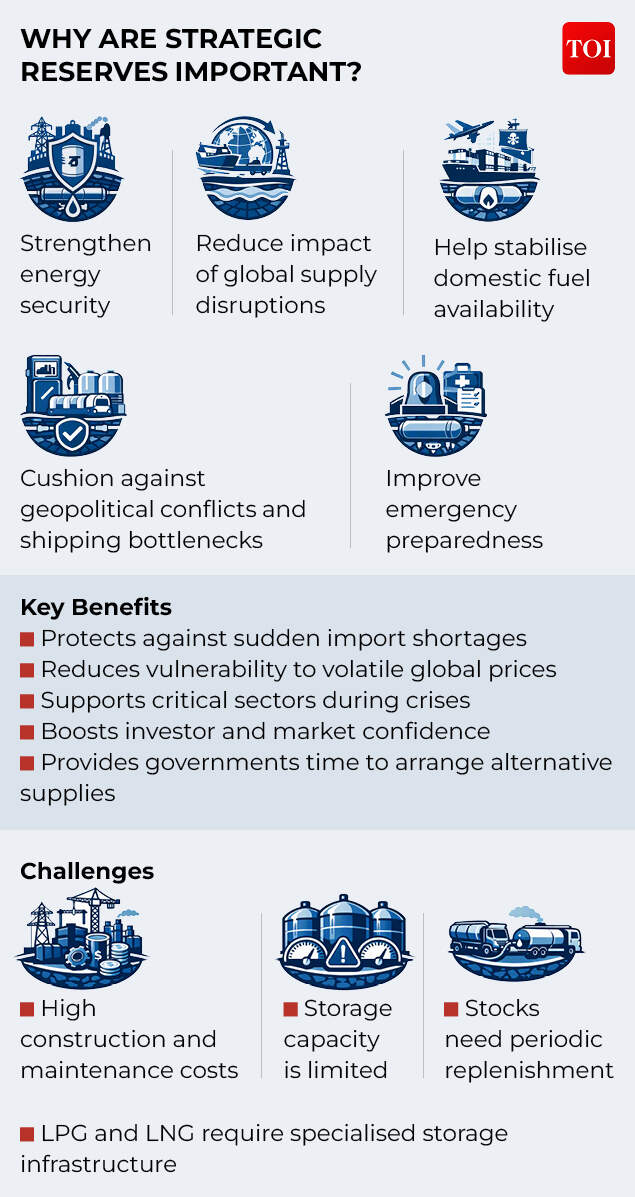
Why are strategic reserves important?
Mitra of Grant Thornton India says, “India currently has a negligible amount of strategic reserve. The policy should mandate a dedicated 25-40-day strategic reserve through salt-caves and an additional 30 days commercial buffer through import terminals, refineries, bottling plants, etc. to prevent panic buying and encourage public welfare.”As Pranab Master says: The government has already indicated a target of about 30 days of LPG storage, in line with India’s target. CRISIL expert believes that the strategic reserve policy design of LPG should be different from that of crude oil. The focus should be on distributed resiliency, not just large-centralized storage.He says that LPG reserve policy should be made keeping in mind the following aspects:-
- Regional and inland storage to manage port congestion, monsoon-related disruptions, transportation disruptions and local demand surges.
- Mandatory Minimum List for Oil Marketing Companies.
- Priority allocation rules for households and essential users during supply stress.
- Better last-mile flexibility through bottling plants, rail connectivity, road logistics and cylinder distribution networks.

From reactive to flexible strategy
lng strategy
Experts agree that in the case of liquefied natural gas (LNG), storage is not only challenging but also very expensive.Kpler’s Sumit Ritolia is of the view that for LNG, the strategy needs to be differentiated from crude as large-scale LNG storage is quite expensive and technically challenging.“However, with 95-100% import dependence, India should still aim for 40-50 days of physical LNG inventory, complemented by diversified long-term supply contracts, destination-flexible cargo, floating storage where economical, and imports from multiple suppliers such as Qatar, US, Australia, Oman and Russia. Energy security for LNG should depend on both physical storage and contractual flexibility,” he told TOI.Pranab Master also says that India should not try to create reserves equal to crude oil for LNG.“LNG is cryogenic, expensive to store, and subject to boil-off losses. Long-term LNG storage is not economically efficient. The right architecture should be a combination of Regas terminal tankage buffer, underground storage and flexible LNG contracts with the flexibility to adjust volumes, delivery times or cargo destinations,” he tells TOI.Japan, one of the world’s largest LNG importers, has LNG storage infrastructure equivalent to approximately 36 days of gas demand, complemented by the recently introduced Strategic Buffer LNG (SBL) mechanism, which enables additional LNG to be made available to priority sectors during periods of supply disruption.He further said, “India is moving in a similar direction through the Ministry’s draft proposal to require new LNG terminals to maintain approximately 10% excess storage capacity, which is a positive step towards improving supply flexibility without significantly increasing costs.”

Focus on ability to respond quickly
What should be the strategy now?
But as the strategic stockpile expands, so do the immediate needs and vulnerabilities. Most strategic petroleum reserve projects have long construction periods, and India’s diversified energy procurement strategy in the interim will be important in mitigating risks.Saurav Mitra says that considering the time required for feasibility studies, land acquisition, environmental and statutory clearances, cavern leaching, construction of surface facilities, pipeline connectivity and inventory build-up, the entire strategic reserve system in crude oil, LPG and natural gas is estimated to be fully realized around 2033-2036.“In the interim, India should focus on rapidly increasing the physical inventory rather than waiting for new caves to become operational,” he says, advocating the following:
- For crude oil, the objective should be to progressively move towards 90 days import cover through a combination of SPR, refinery stocks and foreign storage partnerships.
- For LPG, where import dependence creates a significant vulnerability, India should aim for 30-40 days of dedicated inventory through expanded terminal storage while developing underground LPG caverns.
- For LNG, the priority should be to establish strategic storage of 15-30 days through additional LNG tankage at already existing regasification terminals and future storage facilities.
“This approach will materially strengthen energy security over the next 3-5 years, while long-term strategic reserve projects are being developed,” he told TOI.

Interim strategy is also important
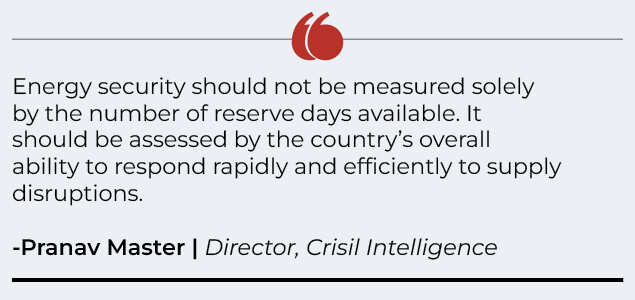
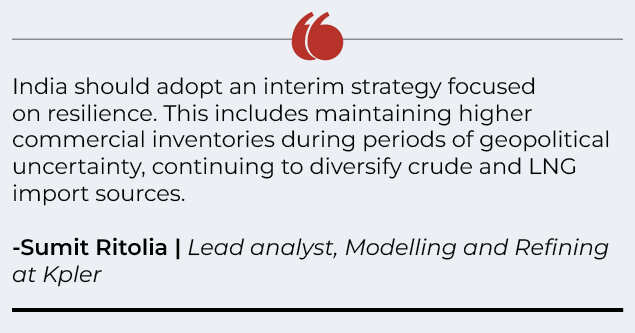
“The ongoing expansion of India’s strategic crude oil reserves, including Phase-II SPR projects, is likely to take 4-7 years to become fully operational after financial closure and construction. Similarly, new LPG caverns and LNG storage infrastructure typically require 4-7 years, meaning meaningful addition to strategic storage capacity is unlikely in the near term,” says Sumit Ritolia.“Until these projects are completed, India should adopt an interim strategy focused on resilience. This includes maintaining high commercial inventories during periods of geopolitical uncertainty, continuing to diversify crude and LNG import sources, using leased storage where commercially viable, strengthening long-term supply agreements and opportunistically building inventories during periods of low international prices. Together, these measures will enhance India’s ability to withstand prolonged supply disruptions, while expanding permanent strategic storage capacity,” he further said.CRISIL’s Pranav Master concludes that energy security should not be measured only by the number of reserve days available. This should be measured by the country’s overall ability to respond quickly and efficiently to supply disruptions.“A balanced approach that combines strategic petroleum reserves, adequate commercial stocks, diversified sourcing and strong logistics and infrastructure will provide a more resilient and cost-effective energy security framework, while additional strategic storage capacity is being developed and commissioned,” he says.