


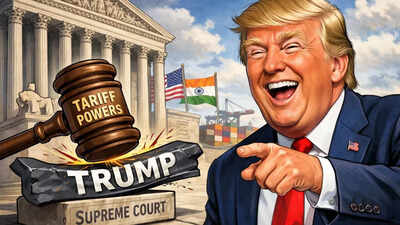
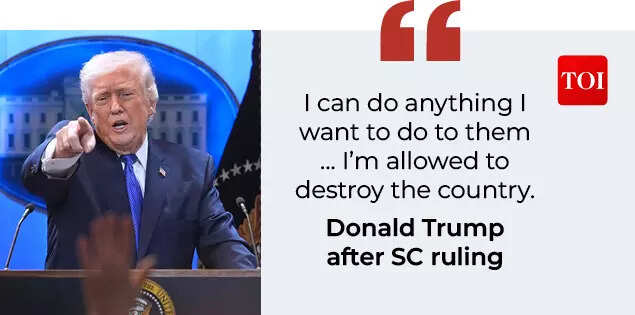
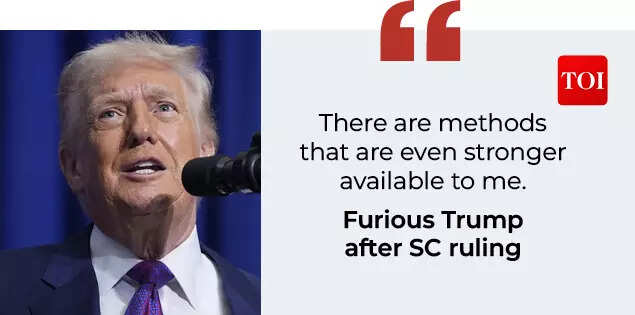
“I can do whatever I want,” Donald Trump said on Feb. 20, quickly expressing his anger over the US Supreme Court’s landmark ruling rebuking his use of emergency powers to impose sweeping import tariffs, one of the most consequential defeats of his second term.The ruling invalidated his use of emergency powers to impose the largest increase in US tariffs since the 1930s, a cornerstone of his trade and economic strategy.In his White House address he added, “There are ways that are even stronger for me.” However he ordered the imposition of a 10% global tariff on top of the normal tariff already being charged.Disgusted and incensed by the Supreme Court’s decision, Trump said on Truth Social, “It is my great honor to sign from the Oval Office a global 10% tariff on all countries, effective almost immediately.”Invoking Section 122 of the Trade Act of 1974, he announced an executive order imposing additional levies, a provision that allows a temporary import surcharge of up to 15% for 150 days to address balance of payments deficits.“Effective immediately, all national security charges under Section 232 and existing Section 301 charges remain in place,” Trump said.A day later, he moved on. Calling the court’s decision “ridiculous and poorly written” and “extraordinarily anti-American”, Trump increased the global tariffs to “fully approved and legally tested” by 15%.He posted, “After several months of contemplation, based on a thorough, detailed and exhaustive review of the ridiculous, poorly written and exceptionally anti-American decision issued yesterday by the Supreme Court of the United States of America on tariffs, please represent this statement that I, as President of the United States, will impose a 10% worldwide tariff on countries effective immediately… up to the fully permitted and legally tested level of 15%.”Their defiance underlined a broader political reality! Even if forced to do so, Trump is unlikely to back away from tariffs as an economic and geopolitical instrument.Could the court’s intervention paradoxically provide Trump with a strategic reset?

What did the Supreme Court say?
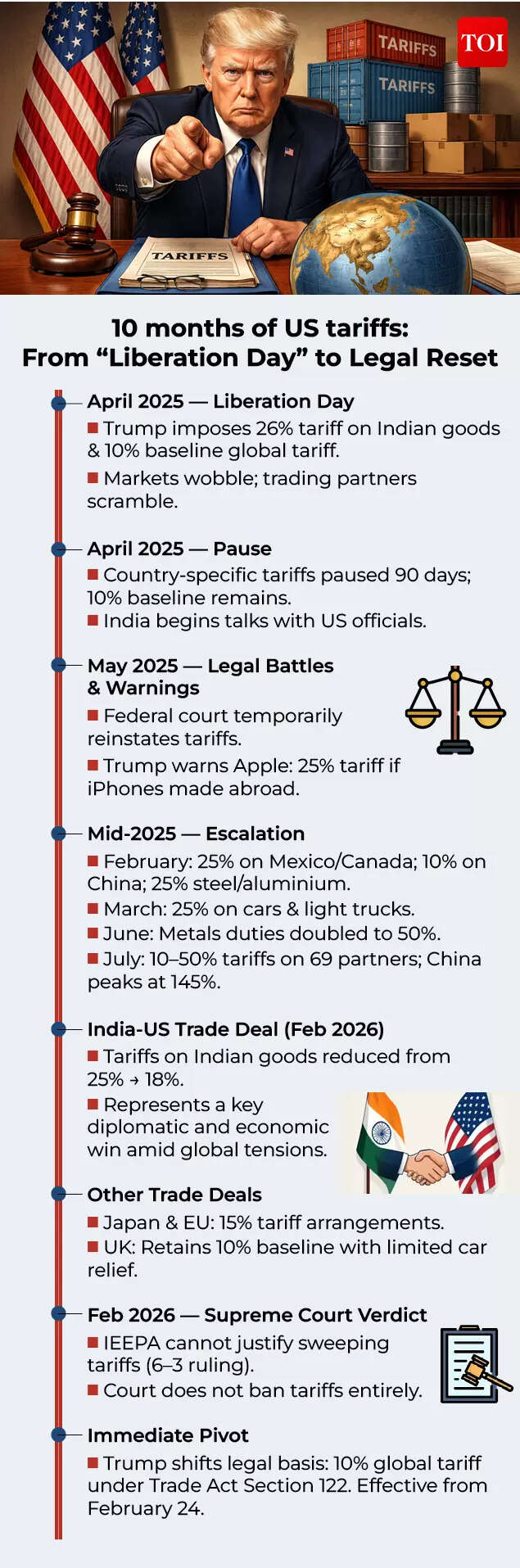
In a 6-3 decision, the Supreme Court examined the tariffs imposed under IEEPA, a statute typically used to freeze assets or block financial transactions during national emergencies.Writing for the majority, Chief Justice John Roberts issued a sharp rebuke. The court said that the President does not have the power to impose import duty under IEEPA.The decision stated that “If Congress had intended to confer an exclusive and extraordinary power to impose tariffs, it would have done so expressly.”The ruling upheld earlier findings of the U.S. Court of International Trade and a federal appeals court, both of which had concluded that the IEEPA does not automatically grant the President unilateral tariff authority.Importantly, the decision invalidated the use of a 1977 statute that accounted for nearly two-thirds of the $200 billion in tariff revenues collected in 2025.From a constitutional standpoint, the Court reaffirmed Congress’s authority over taxation and placed clear limits on the President’s emergency powers.

kavanaugh factor
Trump was quick to highlight dissenting views. He praised Justices Clarence Thomas, Samuel Alito and Brett Kavanaugh for voting to preserve his tariff authority.He paid special attention to Kavanaugh.Addressing the briefing, Trump said, “As for Justice Kavanaugh, whose stock has risen so high, you have to see, I’m very proud of him.” He wrote in his dissent, “Although I strongly disagree with the court’s decision today, this decision cannot impair the President’s ability to order further tariffs.”Trump seized on that line.“So think about, ‘The decision can’t be disrupted to a great extent.’ And it is not so. He is right. In fact, I may be charging more than I was charging. So I’m just going to start,” he said.“This is because numerous other federal statutes” which, of course, “authorize the President to impose tariffs” may justify most, if not all, of the tariffs issued in this case. In fact, even higher tariffs,” he said.“‘Those statutes include’ Think about ‘those statutes include, for example, the Trade Expansion Act of 1962, Section 232’ These are all things I know well, ‘the Trade Act of 1974, Sections 122, 201, 301, and the Tariff Act of 1930, Section 338.'”“I also want to thank Justice Kavanaugh, honestly, for his talent and his great ability. Very proud of that appointment,” Trump said.“In fact, while I’m sure he didn’t intend to do that, today’s decision by the Supreme Court has made the President’s ability to regulate trade and impose tariffs more powerful and more clear, rather than curtailed. I don’t think he meant it that way. I’m sure he didn’t. It’s terrible.”Whether a rhetorical flourish or a legal strategy, Trump appears determined to treat the decision as a clarification rather than a hindrance.
Political slap or strategic cover?
From a domestic political perspective, the decision was widely interpreted as a blow to Trump. The court consists of several judges appointed during his tenure, and its decisions targeted what many saw as his favorite executive levers – the ability to rapidly impose tariffs as a form of economic pressure or geopolitical retaliation.The decision temporarily removes his ability to threaten immediate tariff action against European countries that oppose his Greenland plan or countries like India for maintaining oil trade with Russia.Yet this decision is more narrow than it first appears.Although the Court invalidated the tariffs under the IEEPA, it did not abrogate other statutory authorities available to the President. Trump has already turned to Section 122 of the Trade Act of 1974. Trade experts say it can also rely on Sections 232 and 301 for sector-specific duties.US Trade Representative Jameson Greer had indicated this in December. “From the beginning of these negotiations, at least internally, the idea has been that there will be a recalibration at some point,” he said.Greer said the administration is committed to tariffs as a tool to manage the trade deficit and combat unfair practices. “I am confident that with the other tools we have regarding unfair trade practices we can generate the necessary tariff rates,” he said.Viewed through this lens, what appears to be a humiliating judicial defeat may provide political cover for refining an unpopular tariff regime while preserving its strategic objectives.The economic consequences of Trump’s tariff policies have been intensely debated. While inflation and consumer prices grab the headlines, economists argue that the more corrosive impact lies in growth, investment and labor markets.Kent Smetters of Penn Wharton Budget Model argues that tariffs have made the US less attractive for investment by increasing business costs. “There is little evidence that a major renaissance of American manufacturing is taking place,” Smeters says.He compares the tariffs to a huge increase in corporate taxes, which is tantamount to raising the rate from 21% to 36% and cutting profits by the same magnitude.Research from the Federal Reserve Bank of Kansas City estimates the direct impact of import taxes resulted in 19,000 fewer jobs per month from January to August 2025 – likely an understatement.Meanwhile, analysts at the Urban-Brookings Tax Policy Center estimate that if invalid tariffs are not replaced, real income could rise by $1,200 per household in 2026.Public sentiment reflects tension. A December NPR-PBS News-Marist poll found that only 36% of Americans approved of Trump’s handling of the economy, while two-thirds were concerned about the impact of tariffs on their finances.In this context, the court’s decision could allow Trump to seek recount without surrender.“Yes, there is a loophole as you know they have again imposed 15% tariff across the world through a separate law,” Jawaharlal Nehru University professor Rajan Kumar told TOI.

Does this decision give India more room for negotiation?
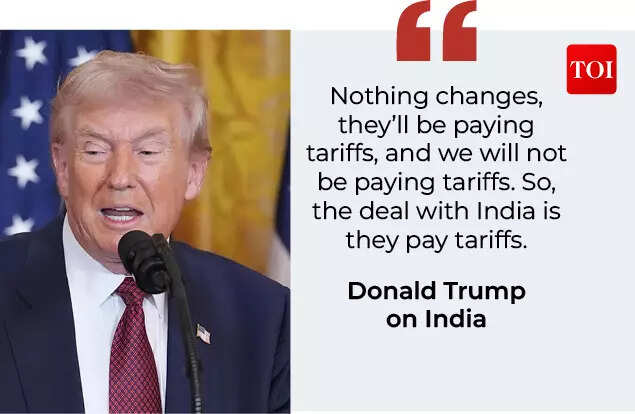
On August 6, the US had announced an additional 25% tariff on India’s Russian oil purchases, taking the total tariff burden on Indian exports to 50%, effective August 27, 2025.In early February, the two countries agreed to an interim trade deal, reducing US tariffs on Indian goods from 25% to 18%. In return, India reduced tariffs on American goods to zero.After the Supreme Court ruled country-specific tariffs illegal, Trump imposed a 10% global tariff applicable to all countries – which was later increased to 15% under Section 122.According to a White House official quoted by ANI, at the moment, India pays the universal rate “unless another authority applies.”Yet Trump had earlier said nothing had “changed” for India and the terms of the trade deal would remain in place.The result is a diplomatic gray zone.“From a broader US domestic political perspective this is without a doubt a slap on the face of Trump, but Trump is Trump, given the way he adopts. And there is huge uncertainty and now whatever has been negotiated will have to be renegotiated,” Rajan Kumar told TOI.He also said that if the tariff arrangement was deemed illegal, the pre-negotiated reductions could be investigated. “As far as India is concerned, this is a period of uncertainty because if the entire process is illegal then the entire negotiation of tariffs coming down from the earlier 50% to 18% is illegal, which lacks clarity,” he said.Uncertainty in trade diplomacy can cut both ways. This may undermine credibility, but it reopens the bargaining space.
So is the Supreme Court’s tariff decision secretly a gift to the President?
Legally, it restates the authority of Congress and restricts the executive’s reach under emergency powers.Politically, this allows Trump to blame the judiciary for economic friction while rebuilding his tariff framework under alternative laws.As Kumar says, Trump “will definitely try to turn uncertainty into a gift by negotiating with countries on their own terms.”