
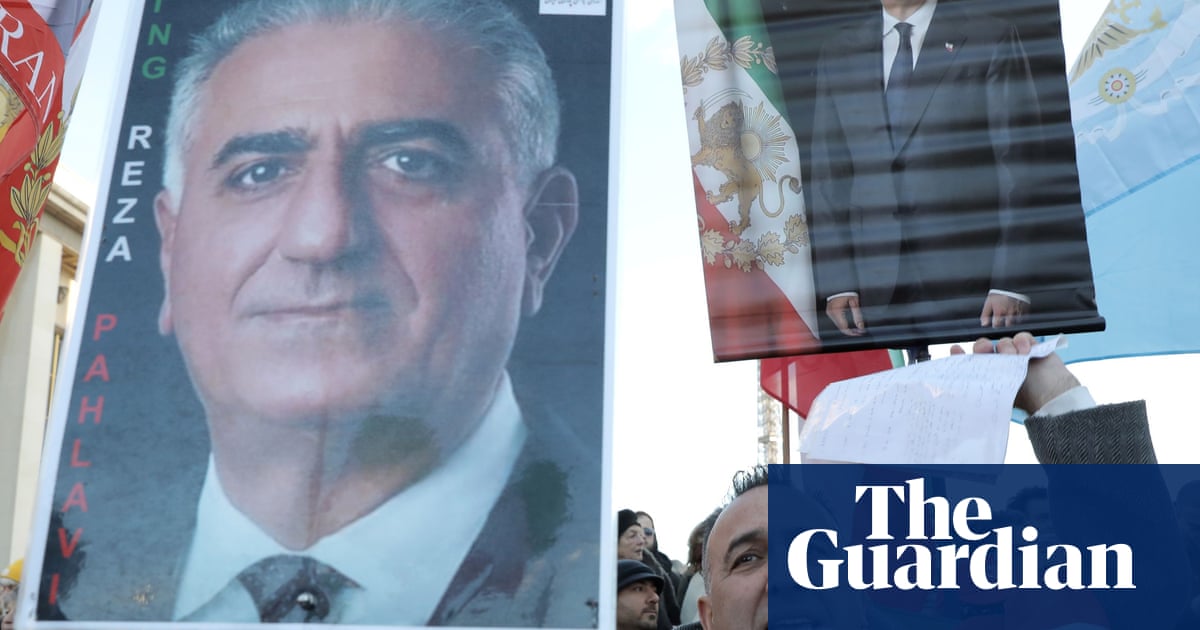
Supporters of Reza Pahlavi, the exiled son of the deposed Shah of Iran, claimed that the crowds on the streets of Iran were a direct response to his call to action. They described it as a referendum on his leadership and that the response showed he had won.
However, the question of an alternative leadership for Iran remains unresolved. Many Iranians, eager to end the clerics’ 47-year rule, still view the return to monarchical rule with suspicion.
On the international stage, Donald Trump has not yet endorsed Pahlavi.
Pahlavi supporters, even on foreign satellite channels, highlight the numerous calls for the shah’s return heard among the crowds. However, just as Trump did not rush to endorse the candidacy of Venezuelan opposition leader María Corina Machado, the US president is equally cautious about Pahlavi, apparently fearing that the United States could end up embroiled in a civil war.
The lack of clear alternative leadership or even a single set of political demands from the protesters, other than ending corruption, repression and inflation, has been a blessing for Pahlavi, as he at least has name recognition and has fueled support for the monarchy for decades.
Others within Iran capable of leading the country toward a secular future, such as Narges Mohammadi and Mostafa Tajzadeh, have been imprisoned sporadically for years.
An Iranian described Iran as a country living in an era without manifesto politics.
Pahlavi, who called on his supporters to take to the streets again on Friday, will attend an event in Mar-a-Lago, Florida, on Tuesday, but his team stressed that he had not yet been granted a meeting with Trump, and that the event, a prayer breakfast in Jerusalem, was not related to the US president’s team.
In a sign of Trump’s caution, the president has also avoided fulfilling his unspecific promise to help the Iranians if they were under attack.
Trump’s caution has led to reports that the president could be exploring a deal with a dissident group within the government. Officials from Oman, traditional mediators between the United States and Iran, will be in Tehran this weekend. Although desperation is raging, there are no signs that the panic that has gripped parts of the government is forcing the supreme leader to rethink his determination to retain Iran’s uranium reserves or his aspirations to enrich uranium within the country. For him it is a symbol of national sovereignty.
But Trump may also be wary of fully embracing Pahlavi, as it is possible to misinterpret calls for his return.
In an internal analysis provided to The Guardian, an Iranian said: “What you hear in the slogans today is not a call [to] return to the crown; It is an escape from a dead end. A society that has no way out regresses, not out of interest, but out of obligation. This retreat is not a choice; It is the nervous reaction of a tired political body that no longer responds to recipes.
“For decades, society was told to ‘wait.’ It waited. It was told ‘it will be fixed.’
“The monarchist motto is not a declaration of love for Pahlavi: it is a declaration of disgust for the Islamic Republic. It is a cry of ‘no’ when there is no ‘yes’ available… Everyone is stuck in the past or in empty promises. When the horizon is empty, society looks back because it sees nothing ahead.”
The Iranian Writers Association also called for caution in the face of “solutions imposed from abroad.”
“Freedom will certainly not fall from the sky with bombs and missiles from predatory powers. Those who have risen up against the status quo while maintaining their independence from domestic and foreign exploiters,” the group said. “We must not wait for an imaginary past and its heralds to be repeated, nor wait for false reformers.”
Pahlavi has always been detested by the left in Iran. The Tehran Workers’ Union and Suburb Bus Company, one of the most prominent independent unions, said Wednesday that it opposes “the reproduction of old and authoritarian forms of power.”
“The path to the liberation of workers does not go through the path of a leader sculpted above the people nor through dependence on foreign powers,” he added.
Either way, Iran’s current reformist leadership, struggling to understand the evaporation of nationalism created by the June 12-Day War, has few solutions left. He can mobilize the people against what he claims are foreign malice and troublemakers. It can be expected that somehow the technocrats at the Ministry of Economy and the Central Bank have mustered the resources to stabilize the currency.
Ahmad Naghibzadeh, professor emeritus of political science at the University of Tehran, warned that the solutions may no longer be technocratic, but historical. He told Euronews: “In the end, there will be no choice but to repeat in Iran what happened in Europe, that is, they decided the dispute between religion and state in favor of the state.”