


India has poked holes in US plans to impose another tariff series linked to alleged forced labour, arguing that its own approach is inconsistent and the issue should be dealt with through bilateral trade talks rather than unilateral action. Speaking before a panel of the US Trade Representative (USTR) on Wednesday, Commerce Ministry Joint Secretary Brij Mohan Mishra raised questions on the basis of the proposed tariffs and highlighted what India sees as inconsistencies in the US framework.Mishra said USTR exempts about 1,600 products from forced labor-related investigations that cannot be produced or developed in the US.Mishra, responding to questions from the USTR panel, said, “What we submit is that the exemption provided by USTR not only undermines the policy rationale for addressing forced labor impacts in global supply chains, but also prevents such impacts from being caused by fraudulent practices.”They also objected to the American practice of offering lower tariff rates on textile products manufactured using American cotton and related inputs.Mishra said, “By providing low tariff rates based on imports of US-origin textile inputs, the textile mechanism acts as an arbitrary requirement that influences and constrains the sourcing decisions of foreign manufacturers, without fully addressing the concern of forced labor.”Raising these concerns, Mishra said India is keen to engage with the US and such issues should be resolved through India-US bilateral trade talks rather than the Section 301 investigation.

Compatible testing, compatible tariff plans
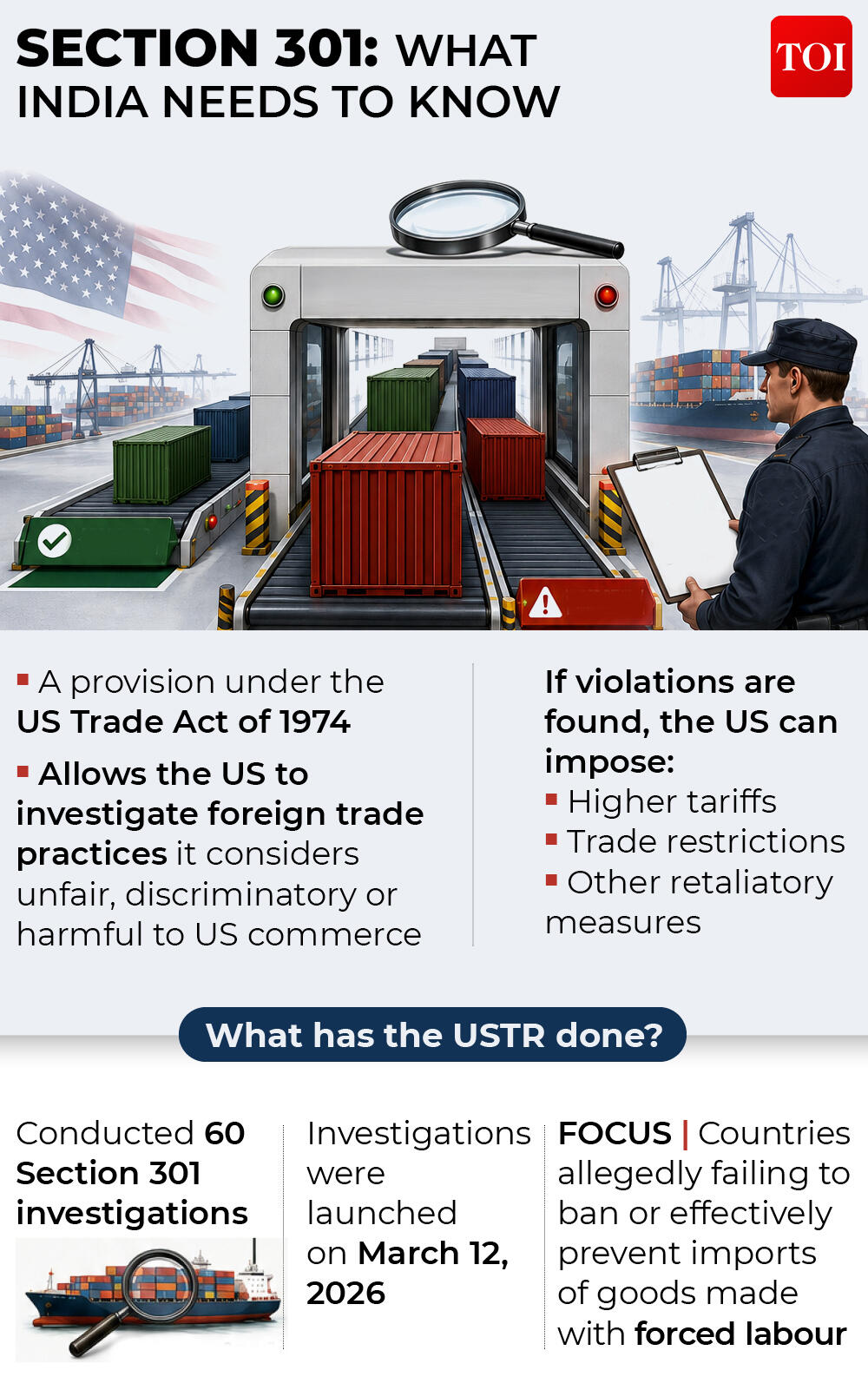
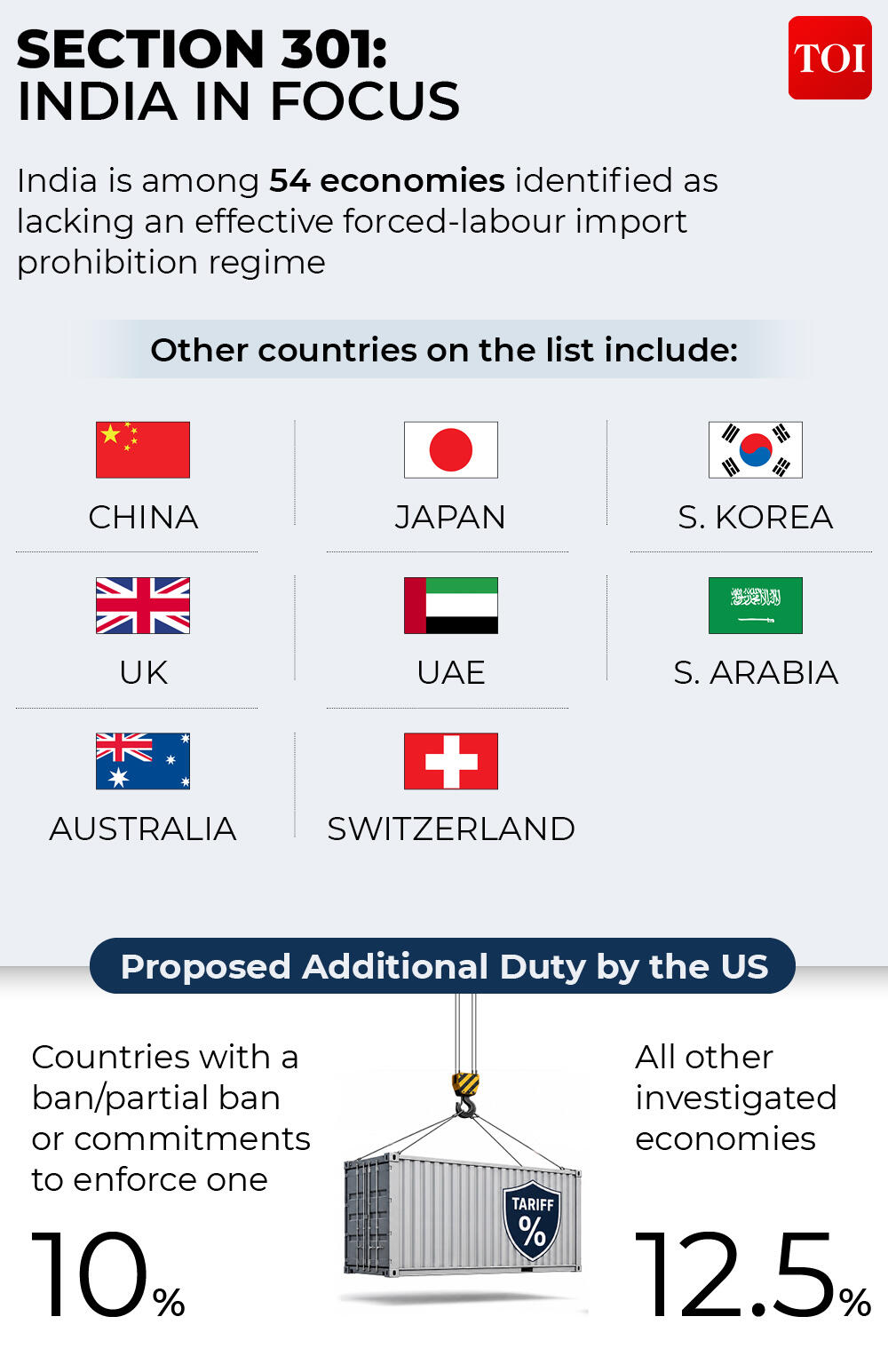
After US President Donald Trump’s global tariffs were overturned by the US Supreme Court, the administration launched a Section 301 investigation. As part of that investigation, the USTR is holding public hearings between Tuesday and Thursday on alleged forced labor practices in 60 economies.It has proposed additional tariffs of between 10% and 12.5% on imports from these economies, alleging they fail to prevent goods made with forced labor from entering global supply chains. Representatives of FICCI and CII also appeared before the panel to present India’s views.Read this also What is India’s strong stance on US Section 301 probe which proposes 12.5% duty? ExplainedFICCI representative in the US Purnima Shenoy said the proposed tariffs would increase costs across the entire supply chain. “Additional tariffs will increase costs not only for Indian exporters, but also for US manufacturers, importers, retailers and ultimately US consumers,” Shenoy said.He said US companies have long-standing sourcing relationships with Indian suppliers because they provide quality, reliability and full compliance.“Higher tariffs for these established supply chains will increase costs for businesses that already adhere to compliance standards. This will not help in identifying goods produced through forced labour. “This will make reliable supply chains more expensive,” Shenoy said.
India denies ‘unfair’ claims
India has also submitted that USTR has failed to establish through evidence that the absence of forced labor import restrictions in these countries substantially distorts market conditions or affects the profitability of complying firms.It added, “India believes that the absence of a forced labor import prohibition, without meeting the evidentiary requirements of other statutory requirements, cannot be considered “unreasonable” within the meaning of section 301 of the Act.”CII representative Suchita Sonalika argued that India’s policy framework cannot be considered “unfair” or “discriminatory” under Section 301(b) of the Trade Act of 1974. He also said that India’s constitutional and statutory framework ensures that companies cannot employ forced labour.

The government further argued that USTR had not conducted an economy-specific assessment of the laws and practices of the 60 economies under investigation, instead issuing a blanket finding without taking into account the specific measures adopted by individual countries.“With respect to India, there is insufficient and insufficient evidence that the lack of forced labor import restrictions causes an alleged unfair comparative advantage to the detriment of US industry. Evidence in sectors of India’s major exports to the US does not suggest any link with forced labor inputs,” it added.
Section 301 investigation
The USTR initiated two separate Section 301 investigations on March 11 and 12, 2026, covering concerns related to forced labor and excess industrial capacity. On June 3, it released its findings into the forced labor investigation and proposed additional tariffs on imports from 54 economies.The Donald Trump administration’s Section 301 investigation has raised uncertainty for many countries, including India. Public hearings on the forced labor investigation are being held between Tuesday and Thursday, ahead of the July 24 deadline for the temporary 10% additional tariff.According to policymakers and trade experts, the pace of the investigation suggests the US could replace the existing 10% tariffs with the proposed forced labour-related tariffs, which would remain in place until July 24. The USTR has not yet released its preliminary findings in separate investigations into alleged structural excess capacity in several sectors.