


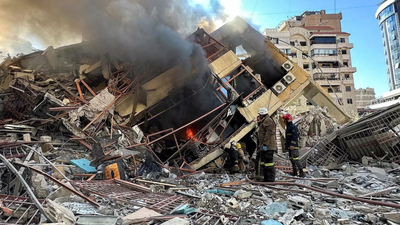
Finance leaders from around the world will meet in Washington this week in the shadow of the Middle East conflict, with the International Monetary Fund (IMF) and the World Bank expected to lower growth forecasts and raise inflation projections as the war disrupts the global economy, Reuters reports.The conflict is the third major shock to the global economy after the COVID-19 pandemic and Russia’s invasion of Ukraine in 2022, putting new pressure on an already fragile recovery.
Top officials at the IMF and World Bank have indicated that emerging markets and developing economies will be hardest hit by higher energy prices and supply chain disruptions caused by the war.Before the clash began on February 28, both institutions had hoped to upgrade their growth outlooks, supported by resilience in global economic activity despite tariff measures introduced by US President Donald Trump last year. However, the war has changed that trajectory.The World Bank estimates emerging markets and developing economies will grow by 3.65 percent in 2026, down from the 4 percent previously estimated, and warns that it could fall to 2.6 percent if the conflict continues. Inflation in these economies is now expected to rise from 3 percent to 4.9 percent, in a worst-case scenario it could rise to 6.7 percent.The IMF has warned that more than 45 million people could face severe food insecurity if disruptions in fertilizer supplies continue.Both institutions are preparing to increase support for weak economies at a time when public debt levels are already high and fiscal space remains limited.The IMF has estimated that low-income and energy-importing countries may need between $20 billion and $50 billion in emergency assistance in the near term. The World Bank has said it can mobilize about $25 billion immediately through crisis response instruments and up to $70 billion over six months if needed.However, economists have cautioned against broad-based fiscal measures to offset rising prices, warning that such steps could worsen inflation, and have instead called for targeted and temporary support.“Leadership matters, and we have been through crises in the past,” World Bank President Ajay Banga told Reuters. He said fiscal and monetary discipline had helped economies deal with earlier shocks. “But it’s a shock to the system.”Countries are now faced with the challenge of addressing long-term issues such as controlling inflation while maintaining growth and job creation for the expected entry of an estimated 1.2 billion people into the workforce in developing economies by 2035.The crisis is unfolding amid a more fragmented global landscape, with rising tensions between the United States and China and the weakening ability of the Group of 20 (G20) to coordinate responses.The United States, which currently holds the presidency of the G20, has excluded South Africa from participation, complicating efforts to build consensus among the major economies.“You’re trying to work on consensus when there’s no consensus on anything in the world right now,” Josh Lipsky, chair of international economics at the Atlantic Council, was quoted as saying by Reuters.Lipsky said the statements from the IMF, World Bank and other multilateral institutions were intended to reassure markets and signal continued support for weaker economies.“This is a signal to private lenders. This is not the time to run away from countries that are in problematic waters. They will get support from multilateral development banks and international financial institutions. It’s not going to be COVID. This is something we can handle,” he said.Analysts say this crisis could prove more challenging than previous shocks for emerging economies, given weak buffers and rising debt levels.Mary Svenstrup, a former senior US Treasury official at the Center for Global Development, said many such economies came into the crisis with high debt vulnerabilities, low reserves and less fiscal space.“We need this crisis to be a catalyst for IMF stakeholders to really rethink how the Fund supports vulnerable countries with the recognition that we are going to see more global shocks,” he said. “We cannot ask them to sacrifice growth and development for reconstruction buffers.”He said any additional financing should be linked to reforms and potentially broader debt relief.Martin Mühlesen, former IMF strategy chief now at the Atlantic Council, said the IMF should work with donor countries to accelerate debt restructuring and help countries exit long-term debt cycles, linking new loans to credible debt-reduction plans.Eric Pelofsky, vice president of the Rockefeller Foundation, said low- and lower-middle-income countries will pay twice as much to repay the debt in 2025 compared with pre-pandemic levels, leaving limited resources for social spending.“This new conflict jeopardizes any recovery that has taken place since the pandemic or the Ukraine war, and it hurts countries that are fundamentally trying to stay away from default, and puts them in a long-term debt-growth-investment trap,” he said.