


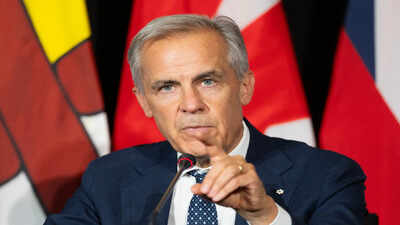
Less than a month before U.S. President Donald Trump’s proposed 50% tariffs are to take effect, Canadian Prime Minister Mark Carney has said Ottawa will not retaliate in advance and will, instead, continue negotiations. Carney said the country did not need to respond “preemptively” and that any such measures would be “counterproductive.” With the tariffs set to go into effect on Aug. 19, Carney said Canada is stepping up efforts to sign a comprehensive trade deal with the United States, but made clear any response would only come if Washington follows through on its threat.“We don’t need to preemptively respond,” he said after meeting with Canadian prime ministers and regional leaders in Charlottetown, Prince Edward Island. “In fact, I think it would be counterproductive to react preemptively at this stage.”He said Canada has not ruled out any measures if tariffs are imposed.“If these tariffs, or other measures, are implemented, there are a number of things we can do in that regard,” Carney said. He said “everything is on the table” if the two sides fail to reach an agreement before the deadline.
America imposed tariffs on Canada
The latest tariff threat, announced by Trump earlier this week, targets a wide range of Canadian exports, including honey, wine, cement, dairy products, some wood products, hockey sticks and other goods. Energy products, potash, fish and critical minerals are excluded, but the tariffs will extend to products previously protected under the United States-Mexico-Canada Agreement (USMCA). The 2020 trade deal was not renewed by the US, setting the stage for a new round of talks that could continue until 2036.
‘Canada will do whatever has to be done’
Carney suggested that threatened tariffs could be part of Washington’s negotiating strategy rather than a final position.“We have seen a series of trade negotiations undertaken by the US and generally there is a time limit to it,” he said. “Usually there is a large tariff associated with that deadline.”He also said he believed US officials were willing to negotiate a trade deal.While talks with Washington continue, Carney said Canada is also working to reduce its dependence on the U.S. market by strengthening its economy domestically and expanding trade with other countries.“Under all circumstances, no matter the outcome of these negotiations, Canada will do whatever it takes to build on our strength domestically and support Canadian families, workers, our farmers, our businesses,” he said.“We are diversifying our partnerships abroad,” he said.According to Prince Edward Island Premier Rob Lantz, the meeting also outlined a unified position among Canada’s provinces.“We need to take a united Team Canada approach,” Lantz said. “Canada is at its best when the provinces and territories and the federal government work together.”Ahead of the meeting, Ontario Premier Doug Ford called for a tough approach to negotiations.“We need a stronger plan,” he said. “Be on the offensive. Put everything on the table.”Asked whether Ontario could impose a surcharge on electricity exports to the United States, Ford replied: “It depends on where we go with the U.S. Ontario stands to lose the most right now. “I will do everything I can to protect the people of Ontario.”Separately, an analysis by Desjardins estimated that the proposed tariffs would affect annual Canadian exports to the US by about 28 billion Canadian dollars ($19.8 billion), which is about 5% of all goods imported by the US from Canada.“Beyond direct trade impacts, increased uncertainty could undermine business confidence and curb investment plans,” the analysis said.The report identified Ontario, Quebec and British Columbia as the provinces most affected.Asked whether any final trade deal with the Trump administration could be trusted, Carney said confidence in the deal would be essential.“I have to reassure, reassure the (negotiating) team and reassure the prime ministers that an agreement is worth the paper it is written on,” he said.