
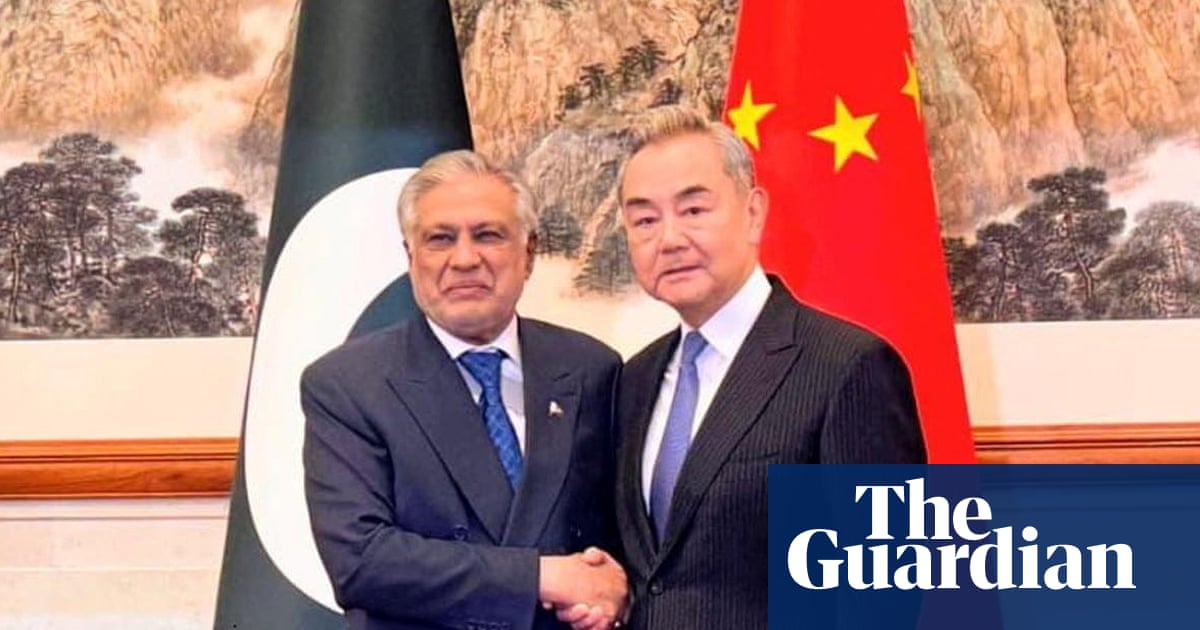
Pakistan and China have released a five-party joint proposal for Middle East peace, after Pakistan’s Foreign Minister flew to Beijing on Tuesday to seek Chinese support for the country’s faltering efforts to negotiate an end to the war.
The day-long meeting between Ishaq Dar and his Chinese counterpart, Wang Yi, came as Pakistan continues to push for the role of peacemaker between the United States and Iran, even as the war shows little sign of letting up.
According to a statement from China’s Ministry of Foreign Affairs, the trip was aimed at “strengthening” cooperation between China and Pakistan in the ongoing conflict in Iran and “making new efforts to advocate for peace.”
China has so far kept a meticulous distance from the ongoing conflict in the Middle East and the Gulf, although it has ties to the regime in Tehran and is the largest buyer of Iranian oil.
While Beijing condemned the initial US and Israeli attacks on Iran, it has since maintained a largely neutral position and focused its efforts on calling for a ceasefire, while negotiating directly with Tehran for the safe passage of its own oil tankers through the Strait of Hormuz.
In a statement after Tuesday’s meeting, Pakistan and China jointly called for an immediate ceasefire and protection of the security of waterways, including the blocked strait, and launched a five-party peace initiative.
The joint statement agreed that dialogue and diplomacy were “the only viable options for resolving conflicts,” but there appeared to be little substantial progress in bringing important players to the table to end the war.
This week, Trump claimed that negotiations with Iran were going “extremely well,” while Tehran has maintained that there are no direct talks at all.
In recent weeks, Pakistan has put itself at the center of efforts to reach a ceasefire to end the war with Iran and has been pushing for Islamabad to be the location for peace talks.
Leveraging their relationships with both sides, Pakistan Prime Minister Shehbaz Sharif and Army Chief Syed Asim Munir have been communicating with US President Donald Trump and Iranian President Masoud Pezeshkian, as well as dozens of other world leaders, with messages between the two warring countries passing through Pakistani intermediaries.
On Sunday, Islamabad hosted talks with the foreign ministers of Saudi Arabia, Turkey and Egypt in an effort to find a regional solution to end the conflict, but the absence of the United States and Iran from the negotiations was seen as undermining its diplomatic clout.
Analysts said Pakistan’s fervent embrace of the role of interlocutor between Iran and the United States came after years of Islamabad being sidelined by Washington under previous presidents and a push by the government and Munir for the country to be seen as a regional diplomatic heavyweight.
Rafiullah Kakar, a Pakistani columnist and political analyst, said: “Islamabad seeks to reinforce its position as a major middle power within the broader Muslim world and signal continued geopolitical importance to external partners, particularly Washington and the Gulf states.”
However, as analysts and political figures have stressed, Pakistan also has a lot at stake in ending the conflict and has already been paying a high economic price for blocking fuel and gas through the Strait of Hormuz.
Pakistan shares a 900-kilometer (560-mile) land border with Iran, and there are fears the conflict could spill over into the restive Balochistan region, which is already battling a violent insurgency.
It is also home to the world’s largest population of Shiite Muslims outside Iran and there are fears the conflict could spark sectarian tensions if it continues to drag on. Dozens of people have already died in protests that broke out when the United States and Israel began bombing Tehran.
The country also has a newly signed defense pact with Saudi Arabia, which could threaten to drag a war-averse Islamabad into war if the Gulf countries decide to adopt an offensive tactic and counterattack Iran’s missile and drone attacks.
Kakar said Pakistan’s keen interest in de-escalating the conflict in Iran reflects both geopolitical and domestic concerns, with fears that it could further undermine the country’s already highly unstable security situation.
“Pakistan remains economically dependent on the Gulf monarchies, particularly Saudi Arabia, and seeks to preserve stable relations with the United States; however, it also shares a long and sensitive border with Iran,” he said.
“Serious instability in Iran would have direct implications for Pakistan’s security. An escalation risks putting Islamabad in a very difficult position.”