



Reliance Industries (RIL) has been granted a general license by the Donald Trump administration, which will allow the company to directly source crude oil from Venezuela without violating any existing sanctions, a Reuters report said.According to the report, this general license allows the acquisition, export and sale of Venezuelan oil that has already been produced, as well as its refining. Reliance had submitted its license application in early January.
Recently, US President Donald Trump removed 25% punitive tariffs on India and said New Delhi will increase oil purchases from the United States and possibly Venezuela as well.Earlier this month, after US authorities detained Venezuelan President Nicolas Maduro, officials in Washington indicated that sanctions on Venezuela’s energy sector would be eased. The move is intended to support a proposed $2 billion oil supply arrangement between Caracas and the United States, as well as a broader $100 billion initiative aimed at rebuilding the country’s oil infrastructure.
Will Venezuelan oil replace Russian supplies?
Issuing such approval to Reliance could speed up shipments of Venezuelan crude while reducing feedstock expenses for the company, which operates the world’s largest refining complex, Reuters reported.

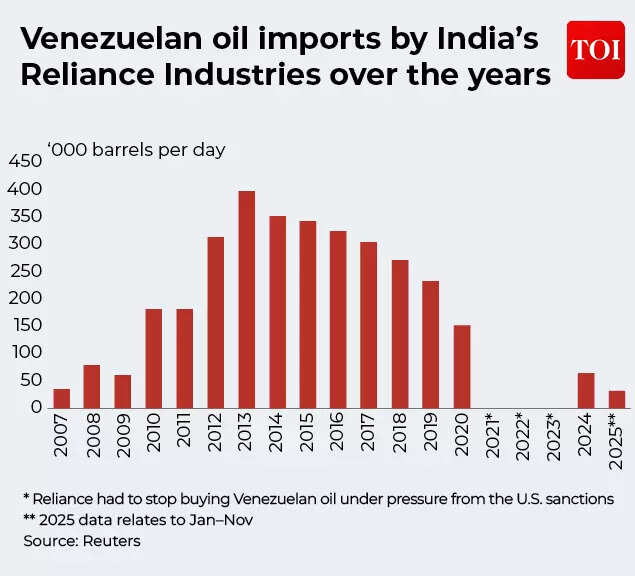
Earlier this month, Reliance had bought 2 million barrels of Venezuelan crude from trading firm Vitol. The trader, along with Trafigura, was given US approval to market and sell large quantities of Venezuelan oil following the capture of President Nicolás Maduro.Buying Venezuelan crude directly would allow Reliance to more affordably replace Russian supplies, as heavy oil from Caracas is usually available at discounted prices, the report said.Read this also Trump lifts 25% punitive tariff: What will happen if India stops buying Russian crude?Indian refiners, including Reliance, are avoiding securing Russian oil cargoes for April delivery and are likely to continue avoiding such deals for some time, refining and trading sources said. Reliance has in the past been a frequent buyer of Venezuelan crude for use at its sophisticated refining facilities, but imports were suspended in early 2025 after US sanctions were imposed. The company currently operates two refineries with a combined processing capacity of approximately 1.4 million barrels per day.