


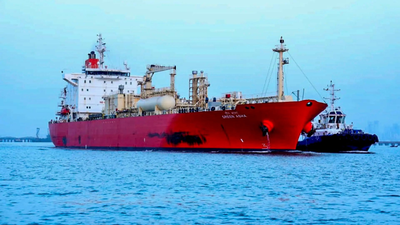
A fragile ceasefire between the United States and Iran has injected cautious optimism into the Strait of Hormuz, one of the world’s most strategically sensitive sea corridors. But despite the diplomatic moratorium, shipping through the waterway still remains disrupted, uneven, and heavily regulated for security reasons.The strait, which connects the Persian Gulf to the Gulf of Oman, is a vital artery for global energy trade, carrying a significant share of global oil and LNG shipments. Even minor disruptions here impact global energy markets, insurance costs and freight logistics.
While reports suggest that limited vessel movements have resumed under strict coordination mechanisms, shipping companies and governments continue to warn that the situation is far from normal. The ceasefire has reduced the risk of immediate escalation, but has not restored full commercial freedom of navigation.Below are key questions to better understand the current reality:1. What is happening in the Strait of Hormuz at this time?The strait operates under a fragile armistice-linked framework where the movement of ships is subject to security coordination rather than limited, conditional and free international passage.2. Has normal shipping resumed after the ceasefire?No. While some movement has resumed, shipping remains well below pre-conflict levels and is still considered disrupted by carriers and maritime agencies.3. How much traffic is currently moving through the strait?Traffic has reportedly declined sharply compared to pre-conflict levels, with only a fraction of normal daily ship movements continuing due to restrictions and precautions by operators. Iran says it will allow only 15 ships a day through the Strait of Hormuz as long as attacks on Lebanon continue.4. Why is the Strait of Hormuz so strategically important?It is one of the world’s major energy chokepoints, handling a large share of global oil and LNG flows. Any disruption immediately impacts global energy prices and supply chains.5. Is the strait safe after the ceasefire?Partially, but not completely. Although the risk of mass surge has reduced, maritime advisories still highlight risks including safety hazards, navigation interference and operational uncertainty.6. What does “controlled transit” mean in practice?Controlled transit means ships cannot move independently and require prior coordination or approval under a managed system, replacing standard international shipping norms with security-based clearances.7. Are ships still at risk despite the ceasefire?Yes. Maritime risk advisories continue to warn about potential targeting, electronic interference and regional instability, meaning the risk has reduced but not disappeared.8. Why are shipping companies still cautious?Because legal uncertainty, unclear clearance systems and increased insurance costs make it difficult to operate normally even when physical routes are possible.9. Are alternative shipping routes being used?Some cargo is being rerouted via regional land bridges and alternative Gulf logistics corridors, but these cannot fully substitute for Hormuz’s maritime capacity.10. Could transit charges or new regulations be introduced?There have been reports of proposed new transit frameworks, including fee-based systems for ships passing through the Strait of Hormuz. Some discussions have also mentioned the possibility of using digital or cryptocurrency-based payment mechanisms, reportedly aimed at circumventing sanctions and simplifying cross-border settlements.However, these ideas remain highly controversial, face significant international legal and diplomatic challenges, and have not been implemented as a recognized maritime standard.11. Why is there confusion over whether the strait is ‘open’?Because “open” means different things in different contexts. Politically, this could mean resuming limited movement under the ceasefire framework. From an operational point of view, shipping firms and maritime agencies say the movement is restricted, conditional and not equivalent to normal commercial navigation.This is also reflected in conflicting political messages. US President Donald Trump has criticized Iran, saying it is “doing a very poor job of allowing oil to go through the Strait of Hormuz” and “this is not the deal we made”, while Iran says any transit conditions are tied to security considerations and broader regional development.As a result, there is still confusion over control and openness of the Strait of Hormuz.12. How are global oil markets reacting?Energy markets remain sensitive, with prices reacting to limited disruption signals due to the Strait of Hormuz’s central role in global oil supply chains.13. Are shipping companies expecting early normalization?No, major carriers are cautious about returning to normal operations. As Maersk notes, “even if conditions improve, operations may take several weeks to return to normal” due to factors such as backlog clearance, insurance recalculations and routing adjustments.14. What role does insurance play in the current disruption?War-risk insurance premiums remain high, and uncertainty over the status of safe passage is discouraging full-scale resumption of shipping.15. What is the main solution to get out of this situation?The ceasefire has reduced the risk of immediate escalation, and ongoing peace talks have created a narrow diplomatic opening. However, the Strait of Hormuz is in a controlled, indefinite phase where limited transit is possible – not a full resumption of normal global shipping conditions.