


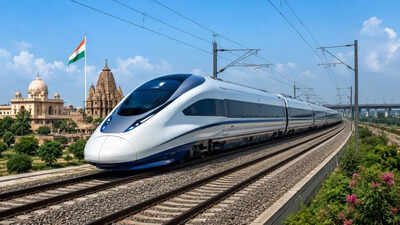
Trains can soon run at a speed of 220 km per hour on Indian Railways, after the Cabinet Committee on Economic Affairs led by PM Narendra Modi has approved a new railway line. CCEA on Wednesday approved the Ahmedabad (Sarkhej)-Dholera semi-high-speed double line project. Railway Minister Ashwini Vaishnav said that the travel time from Sabarmati to Dholera through the new railway line will reduce to 48 minutes.The project will come under the Ministry of Railways at an estimated investment of about Rs 20,667 crore. According to the cabinet release, the corridor will become the first semi-high-speed rail project of the Indian Railways to be developed using indigenous technology.The proposed rail line is expected to improve connectivity between Ahmedabad, Dholera Special Investment Region, the upcoming Dholera International Airport and Lothal National Maritime Heritage Complex. Faster rail access between Ahmedabad and Dholera is likely to significantly reduce travel time, making daily travel and same-day return journeys more convenient for commuters. Being India’s first semi-high-speed rail corridor, the project is expected to act as a benchmark for future phased rollout of similar rail networks across the country, the release said.The new railway line aims to strengthen direct connectivity and improve mobility while enhancing operational efficiency and service reliability for Indian Railways.The corridor has been planned under the PM Gati Shakti National Master Plan with emphasis on integrated planning, multimodal connectivity and logistics efficiency through coordination among stakeholders. This initiative is expected to facilitate smooth movement of passengers, goods and services.Spread over Ahmedabad district of Gujarat, the project will add a distance of about 134 kilometers to the existing railway network. It is also expected to improve connectivity for about 284 villages with a combined population of about five lakh people.Since rail transport is considered energy-efficient and environmentally sustainable, the project is expected to contribute to climate objectives and help reduce the country’s logistics costs. This is also expected to reduce oil imports by approximately 0.48 crore liters and reduce carbon emissions by approximately 2 crore kilograms, this effect is considered to be equivalent to planting approximately 10 lakh trees.