


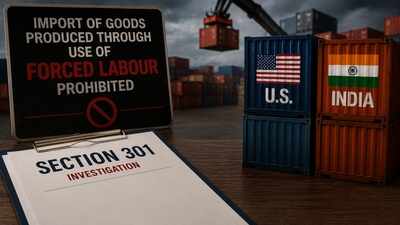
Amid the Donald Trump administration’s Section 301 investigation, the government has revised the Foreign Trade Policy (FTP) to ban imports of goods that are wholly or partially produced through forced labour.The move comes in the backdrop of a US investigation into forced labor practices in 60 economies, including India.According to a gazette notification issued on July 13, through an amendment to the Foreign Trade Policy, 2023, the Directorate General of Foreign Trade (DGFT) has introduced a new provision, which states: “Import of goods produced or manufactured through the use of forced labour, in whole or in part, is prohibited”.The notification said that the new provisions will come into effect after the completion of 30 days from the date of their publication in the Official Gazette.According to the DGFT notification, the Central Government may, at any time, issue a notification banning the import of specified goods if, after investigation or on the basis of any other relevant evidence, it is determined that such goods have been produced using forced labour.The notification also said that the procedure for investigation by DGFT into the use of forced labor in the production of such goods will be prescribed in the Handbook of Procedures, 2023.Further, DGFT has inserted a new provision under Chapter 11 (Definitions) of the Foreign Trade Policy, 2023. Under this provision, “forced labour” means all work or service which is exacted from any person under threat of any penalty and for which the said person has not voluntarily offered himself, as defined under the ILO Forced Labor Convention, 1930 (No. 29).
What is Section 301 investigation by US?
The Office of the US Trade Representative (USTR) is conducting its Section 301 investigations into 60 economies, including India, over concerns related to forced labour. USTR charged that these countries did not effectively enforce restrictions on imports of goods manufactured using forced labor.

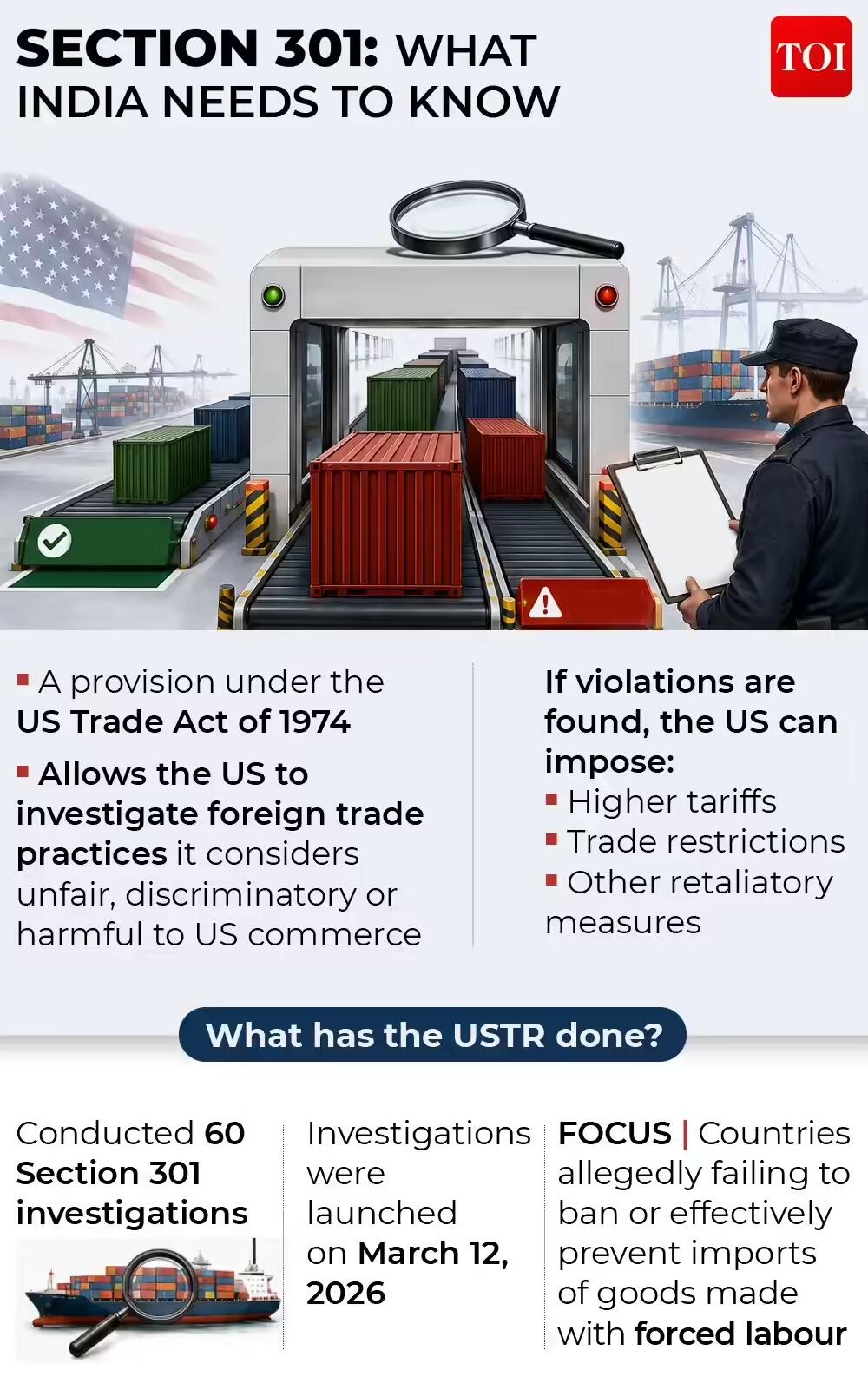
Section 301: What India needs to know
On June 3, the US proposed imposing 12.5% tariffs on imports from 54 economies, including India, on the grounds that they had failed to ban imports of goods produced through forced labour. Separately, Canada, Ecuador, the European Union, Indonesia, Mexico and Pakistan will face additional 10% import duties.India is currently in talks with the US on this issue as both the countries continue to negotiate a bilateral trade agreement.
India’s stance on Section 301 investigation
India has challenged the US proposal to introduce another round of tariffs linked to alleged forced labour, arguing that the US approach is inconsistent and such concerns should be addressed through bilateral trade talks rather than unilateral measures.Appearing before a panel at the Office of the US Trade Representative (USTR) last week, Commerce Ministry Joint Secretary Brij Mohan Mishra questioned the logic behind the proposed tariffs and drew attention to what India considers to be inconsistencies in the US framework.

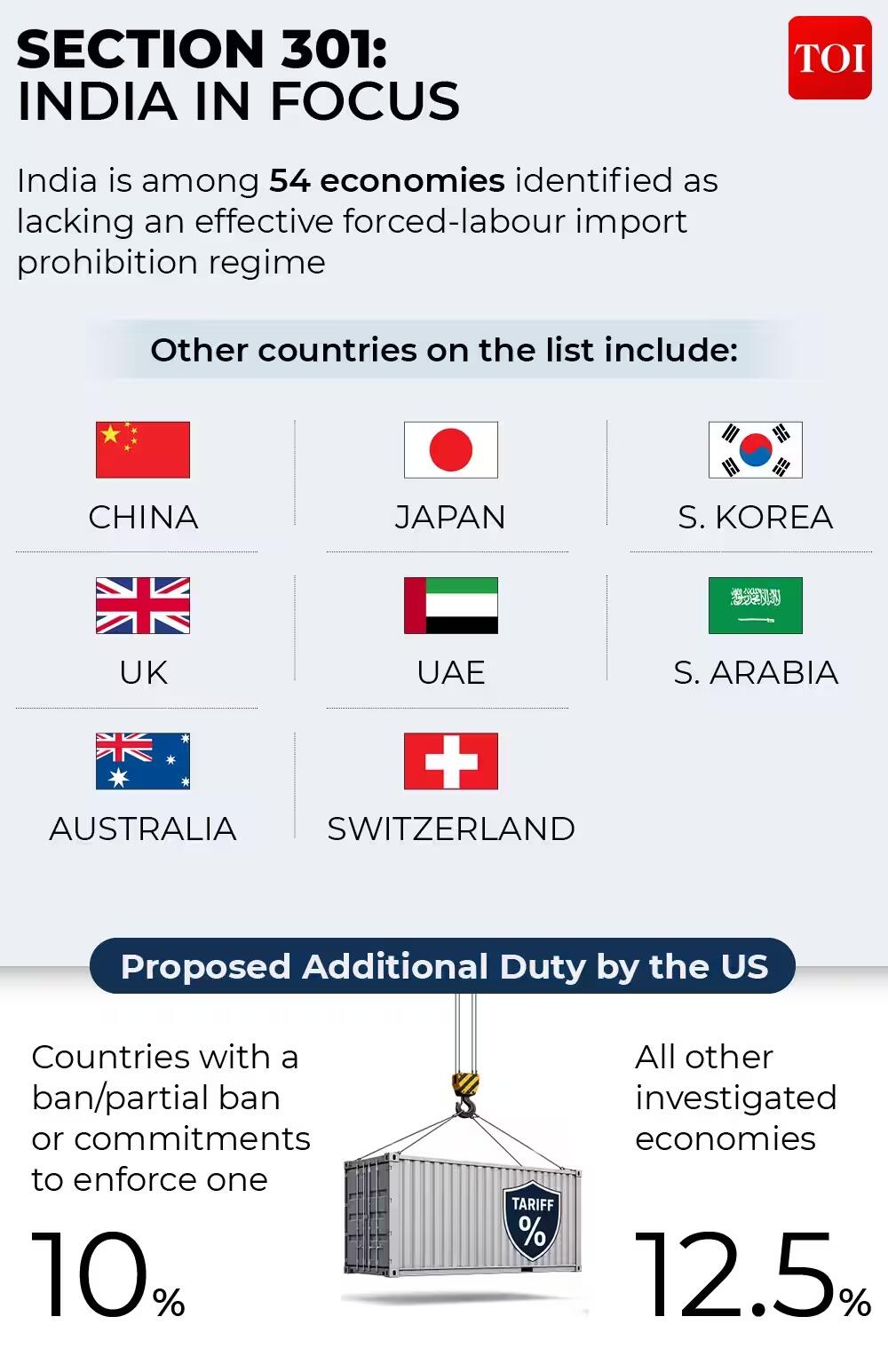
Section 301: India in focus
Mishra said USTR excludes about 1,600 products from its forced labor investigations that cannot be manufactured or cultivated in the US.Mishra, responding to questions from the USTR panel, said, “What we submit is that the exemption provided by USTR not only undermines the policy rationale for addressing forced labor impacts in global supply chains, but also prevents such impacts from being caused by fraudulent practices.”He also criticized the US policy of giving low tariff rates to textile products manufactured using cotton and other related inputs coming from the US.Mishra said, “By providing low tariff rates based on imports of US-origin textile inputs, the textile mechanism acts as an arbitrary requirement that influences and constrains the sourcing decisions of foreign manufacturers, without fully addressing the concern of forced labor.”Presenting India’s objections, Mishra reiterated that the country is ready to engage with the US and said issues of this nature should be resolved through the ongoing India-US bilateral trade talks rather than the Section 301 investigation.
Why is the move on forced labor important?
Manoj Mishra, partner and tax dispute management leader at Grant Thornton India, sees the move as a significant policy change in India’s trade structure. “India has so far largely relied on labor and criminal laws to address forced labor domestically, but the FTP now incorporates a dedicated trade measure in line with international standards under the ILO Forced Labor Convention,” he says.“Announced amid increasing global scrutiny of supply chains and the ongoing USTR Section 301 investigation, this move strengthens India’s regulatory framework on ethical sourcing. However, its practical impact will largely depend on the scrutiny mechanism and implementation framework to be laid down under the Handbook of Procedures, which will determine the scope of compliance for importers,” he further said.Ajay Srivastava, founder of the Global Trade Research Initiative (GTRI), calls India’s notification a sensible first step. However, he says its credibility will ultimately depend on enforcement.“The real challenge is to prove that a product is made with forced labor when production spans multiple countries and opaque supply chains. The US and the EU themselves continue to import significant quantities of products from China in regions where forced labor concerns have been raised, highlighting the practical and political limitations of such measures. For India, the priority should be to create reliable traceability and due diligence systems that protect legitimate trade and ensure that forced labor regulations are not arbitrary. “Don’t create non-tariff barriers.”