


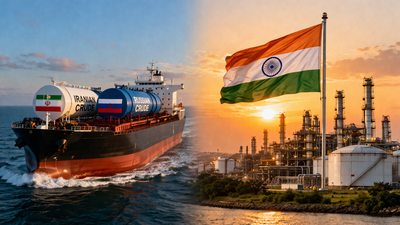
The United States has decided not to extend a temporary waiver that already allowed the sale of Russian and Iranian oil at sea. The announcement came as US Treasury Secretary Scott Besant said on Wednesday, “We will not be renewing the general license on Russian oil,” adding, “That was oil that was in the water before March 11, so that’s all been used up.“This raises a big question: How will the countries that were buying these supplies reshape their strategies now that energy supplies around the world are being disrupted due to the ongoing Middle East war?A similar decision was imposed on Iranian crude oil, signaling a return to strict enforcement under the US “maximum pressure” policy. “We have told countries that if you are buying Iranian oil, if you have Iranian money sitting in your banks, we are willing to impose secondary sanctions,” Besant told reporters at the White House.The waiver was introduced in March as a short-term measure to support war-torn oil pipelines, after the Iran war caused a worldwide uproar. Under the waiver, a 30-day license was granted to transport Russian crude before March 12, which expired on April 11. Another waiver covering Iranian shipments loaded before March 20 is set to expire on April 19, with no plans for an extension.
Sanction relaxation in March – what it means for India
For India, the temporary waiver provided a narrow window to secure supplies, as the country is heavily dependent on imports to fuel its energy needs. Besant had previously reported, “To keep oil flowing into the global market, the Treasury Department is issuing a temporary waiver of 30 days to allow Indian refiners to buy Russian oil. This intentionally short-term measure will not yield significant financial benefits to the Russian government because it only authorizes transactions involving oil already stranded at sea.” During this period, Indian refiners ordered about 60 million barrels of Russian crude. This came after earlier cuts in purchases from companies such as Rosneft and Lukoil due to sanctions-related constraints.India also received Iranian crude oil during this period, the first such import in nearly seven years. The country rushed to bring in supplies before the deadline expired, and nearly 4 million barrels were brought in.The tanker Jaya offloaded Iranian oil at Paradip on the east coast, while another ship, Felicity, arrived at Sikka on the west coast, according to a Bloomberg report citing vessel-tracking data from Kpler and Vortexa. Both tankers were under US sanctions.Paradip handles shipments for Indian Oil Corporation, while Sikka is used by Reliance Industries and Bharat Petroleum Corporation through a single-point mooring facility.Another ship, Deria, which was loaded with crude off Kharag Island in late March, is deployed off India’s west coast. It may have missed the exemption deadline and is currently awaiting further instructions, but there is no confirmation of the discharge port.Follow live updates Here
Key Question – What does the withdrawal of sanctions mean for India
The waivers offered temporary relief to bring in oil supplies as the surge overwhelmed global energy pipelines. For India, they helped manage supply gaps during a period of uncertainty in shipping routes and pricing.Amid the military conflict in the Middle East and the closure of the Strait of Hormuz, India’s crude oil imports from Russia increased in March to nearly $6.2 billion, compared to $1.6 billion in the previous month. Moreover, India’s total crude oil imports fell 4% in March, but imports from Russia rose four times.With both waivers now ending, the country will now have to recalibrate its crude strategy as it continues to deal with disruptions in global oil flows. It is also looking to become self-reliant in the energy sector, expanding capacity in green energy, nuclear energy and thermal generation to reduce dependence on imported oil and gas.Meanwhile, the country’s oil requirements for the coming months are fully secured. The focus has been on crude oil supplies since the Middle East became embroiled in war. On February 28, the US and Israel launched joint strikes on Iran. Since the attack, Tehran has effectively restricted traffic through the Strait of Hormuz, disrupting about 20% of the world’s energy supplies and forcing countries to adopt measures to reduce fuel consumption.