



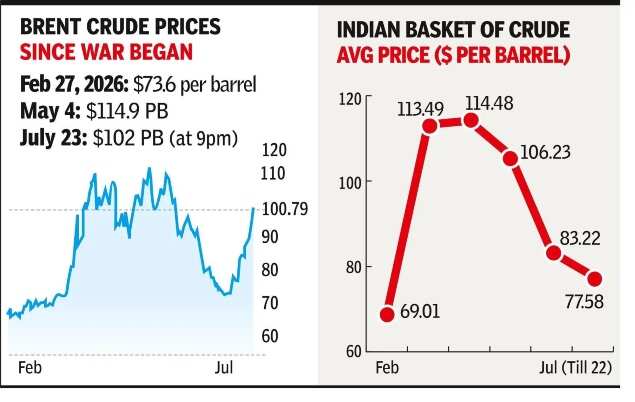
NEW DELHI: Global benchmark Brent crude crossed $100 a barrel for the first time in nine weeks on Thursday as renewed conflict between the US and Iran in West Asia disrupted shipments through the Strait of Hormuz, while Tehran-backed Houthi rebels continued to target shipping through the Bab al-Mandeb strait.Brent jumped nearly 7% in a day and was trading at $100.71 a barrel (8.30am) for the September contract. The Indian basket of crude also hit $93.19 a barrel on Wednesday, nearly 40% higher than the July 2 level of $67 a barrel, when the US and Iran looked set to work on a peace deal.A senior executive at an oil marketing company said the current rise in crude oil prices is related to September contracts and if the trend continues for a few more weeks, the finances of oil retailers could be hurt in the second and third quarters. Following lower realizations on petrol, diesel and domestic LPG during the conflict, oil retailers also broke ground in the last week of June as crude oil prices softened closer to pre-conflict levels. In any case, they were incurring losses on LPG cylinders and this burden would further increase.
Oil prices are rising
In the June quarter, state-owned HPCL and BPCL jointly reported losses of over Rs 14,000 crore, while LPG recorded under-recovery of over Rs 7,000 crore.During an analyst call on Thursday, VRK Gupta, Director (Finance), BPCL, said that June saw a brief period of stability in the markets, but the latest geopolitical developments reminded everyone how quickly they can reshape the operating landscape. The absence of any discount on Russian crude raises concerns, although it provides stability in terms of supply.This time there is additional concern because of the disruption to shipping through the Bab al-Mandeb strait, which officials said could emerge as the next major energy security challenge, threatening crude supplies from both Saudi Arabia and Russia, while pushing up freight costs and global oil prices.Saudi Arabia has begun relying on its East-West Pipeline to carry crude to its Red Sea port of Yanbu, bypassing the Strait of Hormuz. A large number of ships carrying goods from Europe to India and other Asian countries transit the Suez Canal before passing through the Red Sea and the Bab el-Mandeb Strait to reach their destination.Prashant Vashishtha, senior vice president and co-group head at corporate rating agency ICRA, said Saudi Arabia has recently become India’s third largest crude oil supplier after Russia and the UAE. It is supplying 5.5-5.9 million barrels a day to global markets through its Red Sea ports, mainly Yanbu. “If this supply is threatened, it will have an inflationary impact on global crude prices,” Vashishtha said.

