


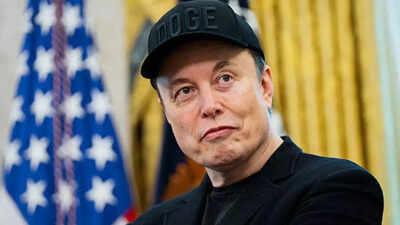
TOI correspondent from Washington: Move over kings, emperors, oil sheiks and that uncle who insists he bought Apple or Nvidia 25 years ago but somehow still drives a 2002 Toyota Corolla or Maruti Suzuki. The world has a new financial lifeform: Elon Musk, the first person to break the mythical $1 trillion net worth mark, skyrocketed by the long-awaited SpaceX initial public offering (IPO).If money talks, Musk’s moolah now needs his own satellite constellation. Investors, apparently deciding that reusable rockets, Mars colonies, and global Internet coverage sound less crazy than some of the things happening on Earth, bumped SpaceX stock up on Friday when it opened at $135.At the time of writing it had reached $170, at which point the underlying company has a valuation of approximately $2.2 trillion (based on 13.08 billion shares outstanding after the IPO). Since Musk is believed to own about 42 percent of SpaceX, when you add the big change from Tesla, Neuralink, etc. it would make him the world’s first trillionaire.At a trillion dollars, the numbers become almost meaningless. One million seconds is equal to approximately 11 days. One billion seconds is equal to approximately 32 years. A trillion seconds ago, our ancestors were wondering whether pounding rocks was an overkill technology.Read this also Khosla and Desai came to Musk-Altman partyMusk’s rise has been so rapid that traditional billionaire rankings now resemble participation trophies. The difference between Musk and the average billionaire is roughly the difference between the average billionaire and someone who is checking whether their bank account can survive another streaming subscription increase.Naturally, the Internet reacted with its usual restraint. On Musk’s own platform, X, one user quipped: “Elon has no net worth anymore. He has GDP.” Another said: “At this point, Jeff Bezos is basically middle class.”The feat also revived one of Wall Street’s favorite pastimes: debating whether Musk is a genius, a gambler, or some hybrid created when Thomas Edison or Isaac Newton collided with Internet trolls.His supporters see him as a visionary who electrified the auto industry, revolutionized space launch and turned science-fiction ideas into business plans. Critics argue that he overpromises, underacts, tweets first – and escalates racist remarks – and thinks later.Both sides can now agree on one thing: the man knows how to make money on audacity.For decades, becoming the richest person in the world meant controlling oil fields, banks, railroads or software monopolies. In contrast, Musk’s fortunes hinge on electric cars, reusable rockets, artificial intelligence bets, brain chips and social media fights made at 2 a.m. This is capitalism with a caffeine – or ketamine – addiction.The SpaceX listing marks a remarkable turnaround for an industry that once relied almost entirely on government contracts. Investors are now putting money on the final frontier, proving that if there’s one thing humanity loves more than exploration, it’s the potential for quarterly returns from exploration.Whether Musk remains a trillionaire or not is a completely different matter. Stock-related fortunes can fluctuate wildly. Markets surge, wobble, panic, and sometimes behave like caffeinated squirrels. Today’s trillionaire may become just 900 billionaires tomorrow.Still, Musk has achieved what was once unimaginable. He’s turned rockets into riches, memes into marketing, and impossible goals into annual guidance.There is an old saying that money cannot buy happiness. But a trillion dollars can apparently buy rocket factories, satellite networks, electric car plants, social media platforms, and perhaps a fairly comfortable seat on the first flight to Mars.As for ordinary people struggling with rent, retirement accounts and rising grocery bills, Musk’s advancement provides a useful reminder. The sky is no longer the limit. It’s just another asset class.


