Elon Musk, according to his own statement, is a modern Cassandra – better than most at predicting the future, but cursed with mistrust. “People don’t realize that what I’m saying will be true,” he told The Economist in a 90-minute interview for The Insider conducted at a giant Tesla factory in Texas. This may be because his visions of the future range from disturbing to downright strange. Mr Musk has predicted that, within five years, artificial-intelligence systems could surpass the sum of all human intelligence. Within ten years, robots in the workplace will help usher in an era of such “prodigious abundance” that money will become meaningless. And within 20 years, Britain – a country he has not visited for years – will be engulfed in civil war.
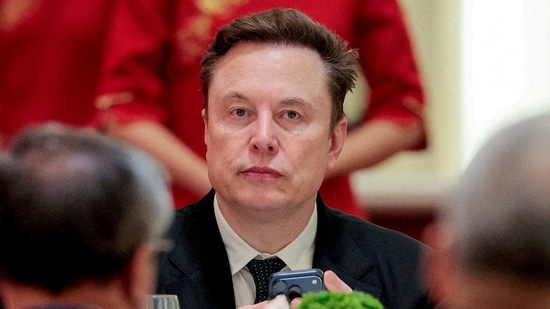
File photo: Tesla CEO Elon Musk holds a mobile phone as he arrives to attend a state banquet with US President Donald Trump and Chinese President Xi Jinping at the Great Hall of the People in Beijing, China, May 14, 2026. Reuters/Ivan Vucci/File photo (Reuters)
Believe it or not, the predictions of Mr Musk, who briefly became the world’s first trillionaire last month, are worth taking seriously. The rocket maker turned AI conglomerate, the driving force behind Tesla and SpaceX, is doing more than any entrepreneur to shape the future. Their influence – powered by feats of money and engineering genius – extends from the White House to global trouble spots like Ukraine. With 240 million followers on his social-media platform X, Mr Musk’s views, especially those that are divisive, wield significant influence.
Wearing black boots and a leather jacket with the logo of his chatbot Grok on the back, he exuded the tenacious single-mindedness that helped him pioneer the mass production of electric vehicles and send a reusable rocket into space against all odds. He also shows that he is intent on shaping his own reality to the point of dogmatism on matters outside his area of expertise.
It was Mr Musk’s first extended interview following the public listing of SpaceX, which soared to a value of $2.6 trillion in the days after it began trading but has since fallen to $1.6 trillion, a fifth below the value it first traded. The main topic of conversation was AI. He says it’s a technique that can take him “from excitement to terror” in a single day. For now, his “philosophical conclusion” is to “look on the bright side.”
This is a choice that easily serves his own interests. Mr Musk believes that AI systems and robots will eventually take over most digital and physical jobs, making the work of humans “substitute”. To that end, xAI (now called SpaceXAI) is developing systems to perform cognitive tasks like software programming, while Tesla is building humanoids. Mr Musk plans to power the entire AI caboodle with data centers in space.
Without jobs, he suggests that creating a “universal high income” for humans may require massive wealth redistribution. But although the world’s richest man says he is willing to pay “trillions in taxes,” he also argues that the money will be irrelevant a decade from now. Thus he argues that governments should simply “issue checks to people”, because amid an unlimited supply of goods and services produced by machines, deflation would be a bigger problem than inflation.
Mr Musk acknowledges that there are imminent risks from increasingly powerful AI systems. Noting that the capabilities of frontier models are rapidly improving, he elaborated on a recent proposal by Google DeepMind co-founder Sir Demis Hassabis to require the US government to establish a self-regulatory body through which the industry would test its own models for threats. Mr Musk argues that this effort should be extended to China, and that major AI labs, including Chinese labs, should get a week or two to inspect each other’s latest models before release, flagging any risks to the governments in both Washington and Beijing. “Competitors can keep each other honest.”
He even suggests that, in order to keep the models safe, he might even be willing to bury the hatchet with OpenAI boss Sam Altman, with whom he has fought a losing battle in court over allegations arising from the days when they co-founded the AI lab. “At the end of the day, if we have to talk, we will talk,” he says, adding that both individuals may need to “put aside their personal differences for the good of the world.”
Mr Musk seems much less concerned about the rise of Chinese labs than other AI bosses like Anthropic’s Dario Amodei. He is impressed by new releases such as KM3, unveiled by Moonshot AI this month, and believes there is a “good chance” that Chinese AI companies will become “leaders at some point”, pointing to the country’s power supply, which significantly exceeds that of the US, and its ability to build robots. (He says he finds videos of Chinese robots tearing each other’s heads off “quite funny.”)
Mr Musk opposed efforts by some Trump administration officials to ban US companies from using Chinese models, saying it would not do much to prevent their manufacturers from winning the AI race. He hopes that China will eventually overcome the shortage of cutting-edge chips resulting from US export restrictions, the absence of which currently prevents it from producing high-end processors in sufficient quantities, by building its own lithography machines. At present ASML, a Dutch firm, holds a monopoly on the sale of the most advanced class of lithography equipment, and is barred from selling them to its superpower rival America. But Mr. Musk says, “China is closer to solving the lithography problem than most people realize.”
The serial entrepreneur is fearless about the amount of power he wields. They argue that AI will eventually control almost everything, and their dominance of SpaceX, where they have more than 80% of the voting shares, is aimed at ensuring that the long-term goal of turning humanity into a multi-planetary species with a colony on Mars is achieved, even if it reduces short-term profits. As far as his dominance of American politics, where his money and influence helped return President Donald Trump to power in 2025 (and briefly put Mr. Musk in charge of dismantling the federal bureaucracy), he says he got too involved. “To be honest, I got carried away.”
Still, he has shown no signs of abandoning the geopolitical bullying platform. Although SpaceX’s Starlink satellites, which provide internet connectivity in remote locations, have been used to help Ukraine repel Russia’s aggression, Mr Musk is adamant that any peace deal must provide territorial concessions to the aggressor. He described the media’s characterization of Europe’s far-right as “false, misleading and nonsense” and argued that it is made up of “ordinary people” who are looking for safe cities, secure borders and sensible spending.
His talks about civil war in Britain stemmed from the view that the influx of people whose views were “contrary to Western beliefs” would be punished. Asked if he was anti-Muslim, he responded: “I’m against rape and murder. I’m against enforcing the rules and laws that we have come to accept in the West, and it’s a shame that the traditional media, like you, don’t recognize that.”
It’s not clear how his bleak vision of the future outside the US matches his AI utopianism. But even Mr Musk wonders whether it all makes sense. Sometimes, he says, he believes in a theory in which the universe is a computer simulation created by aliens. “The things I’m doing are so absurd it’s hard to believe they’re real.”
To keep track of the trends shaping commerce, industry and technology, sign up to “The Bottom Line,” our weekly subscriber-only newsletter on global business.