


Fatih Sik was drinking tea with friends at home when he heard a thud outside that grew into a loud roar, as if a volcano had erupted nearby. From the window, he saw water and mud shooting into the sky, as high as the tallest trees, less than 100 meters away.
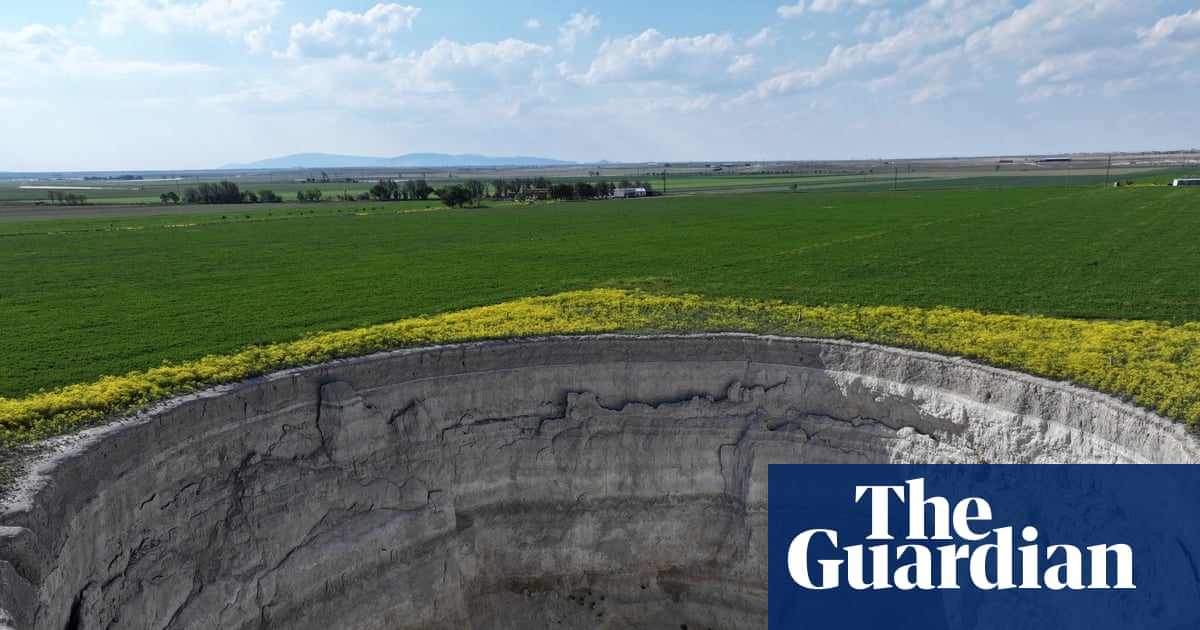
The 47-year-old knew what it was, because it is common in Karapınar, Konya, a vast agricultural province known as Türkiye’s breadbasket. A giant sinkhole had opened in their land. Fifty meters wide and 40 meters deep, it had appeared almost a year after a previous one formed. It was August, the hottest month of the year.
Sik was born on the farm he now owns, which his father ran before him, but says scientists have told local people that the area is no longer habitable. A nearby house collapsed into a sinkhole.
“Every night I pray before I go to bed and when I wake up I pray again,” Sik said. “I live in constant fear that a sinkhole will take away my house.”
Konya, part of the once-fertile Central Anatolia region, gave rise to ancient civilizations, including what is believed to be the world’s first agricultural society, at Çatalhöyük, around 8,000 BC. It is dotted with remains of water cults, sacred Hittite springs and Roman aqueducts, and once offered vital watering holes to Silk Road traders.
But now the land is drying up. Türkiye is on the brink of a major drought crisis, with almost 90% of the country at risk of turning into desert.
Sinkholes are appearing at an increasing rate in the region’s agricultural lands. Experts say there are now almost 700, causing uncertainty and devastation for farmers who live and work there.
According to Fetullah Arik, a geology professor at Konya Technical University who studies sinkholes, the problem is due to decreased rainfall and reduced groundwater. Local farmers are digging deeper and deeper wells due to water shortages, further depleting groundwater reserves and exacerbating the problem.
Konya has always been geologically prone to sinkholes because much of the region lies on foundations of limestone and other soluble rocks, but in recent decades intensive agriculture has led to intense extraction of groundwater for irrigation. As water tables drop, underground cavities lose the support that once held them.
Arik points to a map of global sinks on the wall of his office and says Konya has the highest density in the world. “In the last two years, things have accelerated and the difference is hard to ignore,” he says.
What was once a slow-moving disaster driven by climate collapse has accelerated dramatically. Last year saw record heat and low rainfall, and farmers and fishermen told the Guardian they had seen unprecedented drought. According to local reports, the region has lost 186 of its 240 lakes in the last 60 years.
Prolonged heat waves and periods of drought, once rare in Europe, now cost around €11 billion a year. Central Anatolia faces the brunt in the Mediterranean, one of the fastest warming regions on Earth. However, Türkiye will host the UN climate summit Cop31 this year, sharing duties with Australia and raising questions about its climate leadership.
The country’s climate policies are “highly insufficient” to meet the Paris Agreement goal of limiting heating to 1.5°C above pre-industrial levels, according to Climate Action Tracker.
Sik used to irrigate his crops with additional groundwater once in spring and twice in summer, but now it rains so little that he waters five times and then 10.
“Ten years ago, we only had to go down 30 meters to find water. Now it’s 90,” he says.
By his estimate, there are 100 sinkholes in his neighborhood. Two swallowed up a beet field on his property, costing him around £17,000 a year. He estimates he would need 6,000 truckloads of sand to fill his land and make it usable again, but this would cost almost £35,000.
Sik has not received any support and believes he is the last generation to farm the area. He sent his children to study nursing and dentistry instead of teaching them agriculture.
Most Konya farmers grow water-intensive crops such as corn, wheat and sugar beets. Some believe the solution to the region’s problems is to adapt agricultural practices, growing crops that need less water or no water at all.
Mahmut Senyuz is the head of an agricultural collective that is the first to reintroduce hemp production in the region, which had been slowly phased out due to regulatory restrictions. While he used to water his corn nine or 10 times a season, he said with hemp that is reduced to three.
Meanwhile, Dr. Ece Onur, affectionately referred to by Turkish media as the country’s “most colorful farmer” due to her penchant for wearing flashy overalls, is reviving ancient dryland farming practices. She left behind a career as a military anthropology professor at Indiana University to return to her ancestral lands in Burdur, founding a women-led cooperative and also training producers across the country.
Rainfed agriculture does not use irrigation, but rather prepares the soil and encourages plants to dig deep into their roots to take advantage of natural water reserves. She grows roses and medicinal plants and says these types of crops could be vital for Türkiye’s future.
“Soil is a living organism,” he says. “The only way to solve this crisis is to stop trying to make nature do things our way. We have to imitate it.”


