


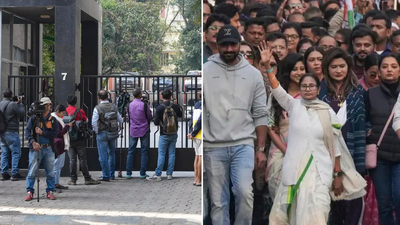
NEW DELHI: An Enforcement Directorate (ED) probe into political consultancy firm I-PAC has become a major political flashpoint in poll-bound West Bengal, putting it at the center of a fierce battle between Mamata Banerjee’s Trinamool Congress and the BJP-led Centre. What began as a money laundering investigation has now expanded into a broader confrontation that includes raids, arrests, subpoenas and the “green file” episode.
From Emergency Department raids to political confrontation
The ED raid became a political flash point when Chief Minister Mamata Banerjee intervened in the ongoing investigation and allegedly intervened in the process by suppressing key evidence, according to the agency.
The ED had carried out searches at several places, including Kolkata and Delhi, as part of an investigation into alleged financial irregularities linked to I-PAC.The agency has maintained that the action is part of a routine investigation and is not politically motivated, saying that the search is based on evidence and is not directed at any political establishment, that no party office has been searched and that it is not linked to any election.The TMC, however, has responded strongly, accusing the central agencies of attacking the party before the elections and turning the probe into a political confrontation.
The high point of the ‘green file’
Mamata’s dramatic intervention came when she arrived at I-PAC co-founder Pratik Jain’s residence during the ED raid.According to the agency, she, along with assistants and law enforcement personnel, “forcibly removed physical documents and electronic evidence” and then went to the I-PAC office in Salt Lake, where similar actions were alleged.Images of Mamata carrying what became known as the “green file” sparked a national debate. The ED said its actions caused obstruction in proceedings carried out under the Prevention of Money Laundering Act (PMLA), while the TMC defended its move, alleging that the raids were aimed at accessing sensitive political material.However, Mamata alleged that central agencies seized sensitive material of the party, including hard drives, candidate lists and strategic documents, and accused Amit Shah of misusing investigative bodies.“Is it the duty of the ED or Amit Shah to take away my party’s hard drives and candidate list? The Home Minister, who cannot protect the country, is taking away all my party documents,” Banerjee said while talking to reporters.Launching a direct challenge, the CM challenged the BJP leaders to take it on politically. “If Amit Shah wants Bengal, come and fight democratically and win. People should know what kind of operation was carried out. At 6:00 a.m. they arrived and seized party data, laptops, strategies and mobile phones. Their forensic experts copied all the data. “I think this is a crime,” he said.
BJP strikes back
BJP leaders have launched a strong attack on Mamata Banerjee over the I-PAC controversy, accusing her of interfering in the ED probe and covering up irregularities.BJP MP Sanjay Jaiswal alleged that the prime minister was “on the side of mafias” and described I-PAC as “a very controversial company”. He stated: “When a raid occurs, the chief minister herself goes there and steals the documents… I-PAC’s job is to work with the mafias, taking money from them to form and overthrow governments.” He further demanded that the Education Department “register an FIR against Mamata Banerjee”.Echoing similar allegations, BJP spokesperson Sambit Patra said Banerjee “obstructed official work” during the ED operation. “Perhaps for the first time in India, a Chief Minister walked in during a raid and tried to eliminate evidence,” he alleged, adding that she “pushed everyone aside and collected physical and electronic evidence,” which he said “proves that she has a lot to hide.”
Coal scam and hawala link
The investigation has its roots in a 2020 CBI case related to an alleged coal smuggling syndicate led by Anup Majhi alias Lala, which involved illegal mining in parts of West Bengal. The ED alleges that the proceeds from this operation were sent through hawala channels to Indian PAC Consulting Pvt Ltd, the registered entity of I-PAC.The agency said the raids were linked to people making profits from charcoal smuggling and alleged that I-PAC is one of the entities linked to hawala money. Investigators claim that a hawala operator facilitated transactions worth tens of millions of rupees to the company.
Arrests and expansion of the investigation
The case escalated in April when the ED arrested I-PAC co-founder Vinesh Chandel in connection with the money laundering probe. It was produced before a Delhi court, which recorded that the agency complied with the legal requirements laid down in the PMLA and that relevant documents and grounds of arrest were provided.The investigation has continued to expand, with director Rishi Raj Singh summoned for questioning and repeated scrutiny of co-founder Pratik Jain. The ED also summoned Jain’s wife and brother, stating that their business links are under scrutiny.
From electoral strategist to point of political tension
Election strategist-turned-politician Prashant Kishor founded I-PAC, which emerged as a leading political consultancy working with multiple parties across India.He has been closely associated with the TMC in West Bengal and has played a key role in electoral strategy.Although founder Prashant Kishor exited IPAC after the West Bengal elections in 2021 and months later launched his own political group, Jan Suraaj, the firm remains active in key electoral states, including West Bengal and Tamil Nadu.
Electoral calendar and political bets
The timing of the raids and arrests, before crucial elections, has intensified the political battle. The TMC has framed the probe as an attempt to disrupt its campaign machinery, while the BJP has used the probe to question the ruling party’s transparency.Mamata also led a protest rally in Kolkata against the ED action, underlining how central the issue has become in the state’s political narrative.
Beyond I-PAC: a broader political battle
The controversy has gone beyond a financial probe and has become a broader political conflict involving allegations of corruption, accusations of political vendetta and tensions between the State and the Centre.With raids, arrests and the “green dossier” episode dominating the headlines, the I-PAC has become a flashpoint in West Bengal politics, a flashpoint that is likely to shape narratives and voter perceptions in the run-up to the elections.
Survey
Should political leaders be allowed to intervene during law enforcement operations?


