


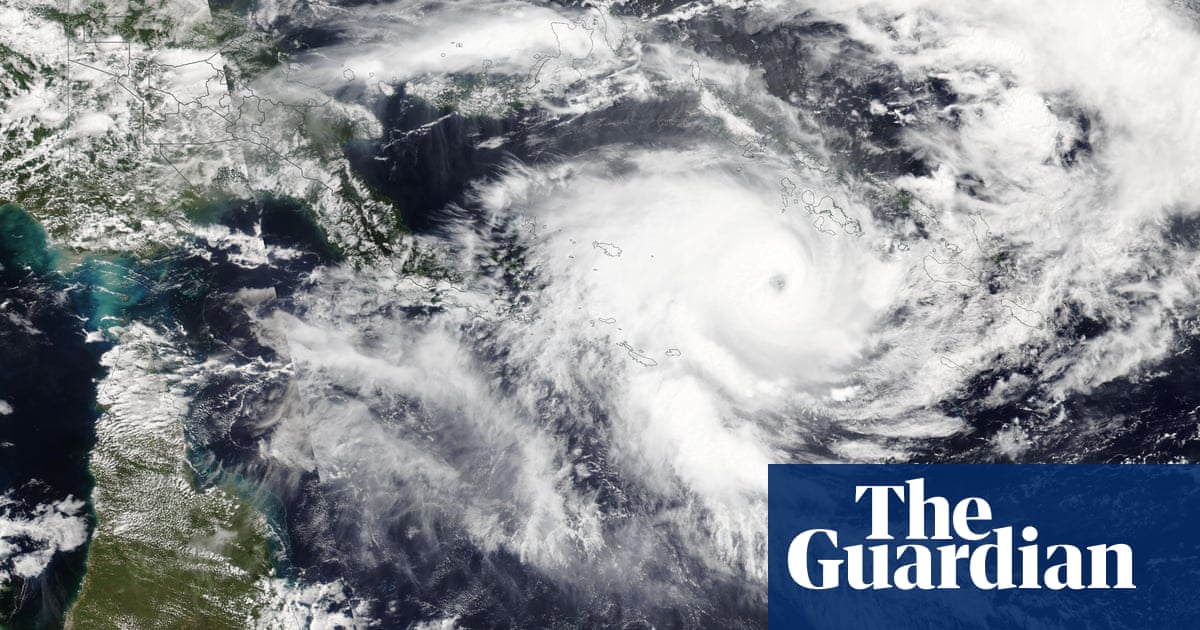
Severe Tropical Cyclone Maila has intensified into a category five storm over the Solomon Sea, days before its expected landfall in Australia.
It is expected to hit the far northern Queensland coast just weeks after the same area was hit by severe Tropical Cyclone Narelle, which made landfall on March 20 as a category four system.
Maila was over the Solomon Sea on Wednesday and was expected to make landfall along the Cape York Peninsula early next week, according to the Bureau of Meteorology.
Another major storm system, Severe Tropical Cyclone Vaianu, was expected to make landfall in New Zealand at a similar time to Maila in Australia, BoM senior meteorologist Ilana Cherny said.
Cyclone Maila has recorded a lower minimum pressure (924 hPa) than Narelle (930 hPa), a measurement that suggests a greater storm intensity.
Cherny said the storm would begin to weaken as it moved southwest toward Australia. “There are still a range of possibilities in terms of how quickly… the system will move towards far north Queensland, but at this stage, it is likely to cross the coast early next week, most likely later on Monday,” he said.
Following a similar path to Narelle, Maila would likely reach the coast somewhere between the Lockhart River and Cairns, Cherny said. “That is without a doubt one of the most important points to watch for in the coming days.”
Queensland communities could begin to see impacts from the weekend onwards, including heavy rain, risk of flooding in already saturated catchments, strong winds and dangerous surf, Cherny said.
There was still uncertainty about the strength of the cyclone as it approached Australia, he said, as Maila “looks like it will approach, if not over, some of PNG’s southernmost islands”.
The effects of the cyclone were felt on Wednesday in the Solomon Islands. Images on social media show the destruction of property in remote areas of the islands’ Occidental and Choiseul provinces.
maila is the seventh The storm will reach severe tropical cyclone strength, above category three, in this Australian cyclone season, which runs from November to April.
According to BoM data since 1980, of the 10 tropical cyclones that hit the Australian region each season, only three or four typically make landfall, and only about five reach severe intensity.
Maila is likely to be “the seventh tropical cyclone to make landfall on the Australian mainland this season and the third to cross the Queensland coast,” Cherny said.
Tropical Cyclone Koji was downgraded to a tropical low just before it hit in January, while last month’s Tropical Cyclone Narelle became the first storm system in more than 20 years to make landfall in three of Australia’s states and territories.
Allow Facebook content?
This article includes content provided by Facebook. We ask for your permission before uploading anything as they may be using cookies and other technologies. To view this content, click ‘Allow and continue’.
Looking further east, Cherny said Severe Tropical Cyclone Vaianu was a category three system on Wednesday, located about 400 kilometers southwest of Nadi in Fiji. “As we often see, it will start to weaken as it moves out of the tropics,” he said.
The system is expected to “become an extratropical cyclone on Friday and move south-southwest toward New Zealand over the weekend,” according to the New Zealand Weather Service.
Most tracking models forecast the system to crash into New Zealand’s North Island at the weekend, with the MetService warning of “damaging and life-threatening winds”.
Liz Ritchie-Tyo, professor of atmospheric sciences at Monash University, said Maila and Narelle formed “relatively close to the equator”, where they were “put under a circulation pattern or directing flow that directs them westwards”, towards Australia.
Global warming is expected to make cyclones less frequent, but those that do form are likely to be more intense.
Preliminary observations suggested that the cyclones seemed to “move a little slower, so when they make landfall, we feel their effects for longer and… they weaken more slowly once they make landfall,” Ritchie-Tyo said.
“Adaptation becomes really important because it may not be about what the strongest wind speed is, but rather how long those winds stay strong and how far inland they stay strong, where we haven’t really prepared or adapted for those types of conditions.”
– with AAP


