


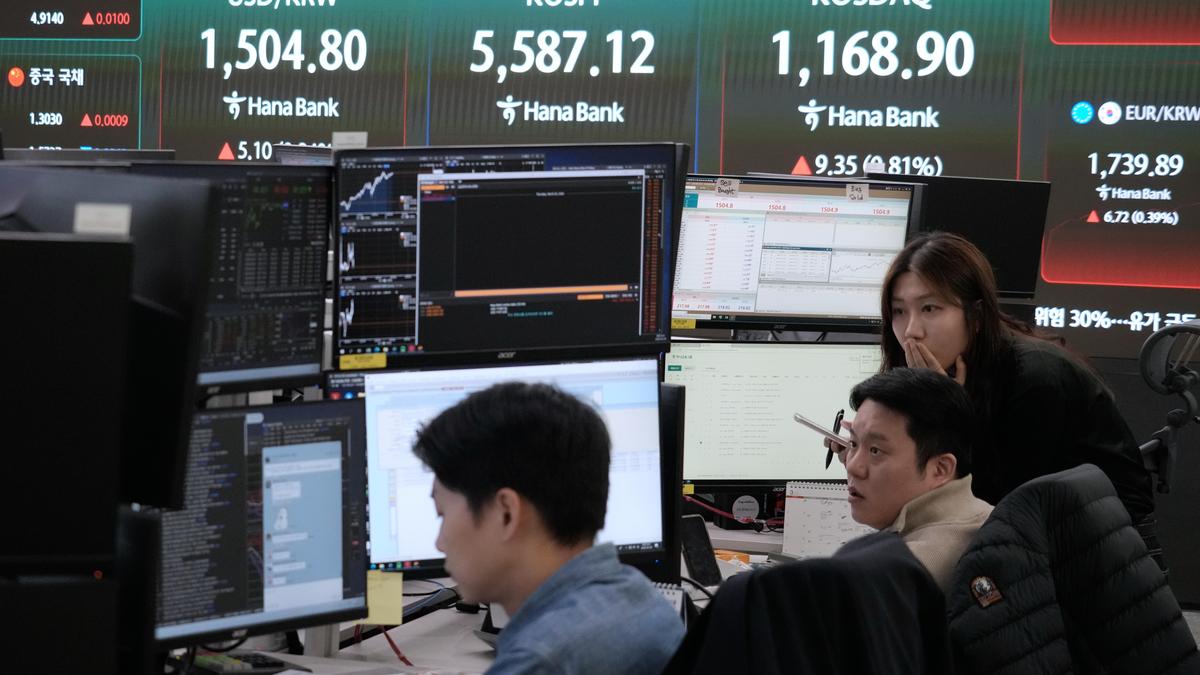
Currency traders look at monitors near a screen showing the Korea Composite Stock Price Index (KOSPI) (top center) and the exchange rate between the US dollar and the South Korean won (top left) in the foreign exchange trading room at Hana Bank headquarters in Seoul, South Korea, on March 26, 2026. | Photo credit: AP
Asian stocks fell in a choppy session while oil rose on Thursday (March 26, 2026), as investors moved cautiously amid the breakneck pace of events in West Asia, with Iran saying it would weigh a US proposal to end the conflict.
Highlights of the Iran-Israel war on March 26, 2025
The escalating war has rattled global markets this month, sending oil prices soaring, reigniting inflation fears and upsetting global expectations about interest rates.
Conflicting messages from both sides about the ceasefire talks have kept investors nervous.
US President Donald Trump said Iran was desperate to reach a deal, while Iranian Foreign Minister Abbas Araqchi said there had been no dialogue or “negotiations with the United States, although several messages had been exchanged through intermediaries.”

Japan’s Nikkei reversed its early gains to trade 0.7% lower, while South Korean stocks fell 2.7% and Hong Kong’s Hang Seng Index fell 1.7%.
MSCI’s broadest index of Asia-Pacific shares outside Japan fell more than 1% and is forecast to fall 9.5% this month, its biggest monthly drop since October 2022.
The gloomy mood will continue in Europe, with stock futures indicating a lower open. US stock futures also fell.
“It looks like the market’s relief trade is starting to falter,” said Charu Chanana, chief investment strategist at Saxo. “Merchants are also remembering that a rumor of peace does not undo inflation and the damage that is already in the system.”

The nearly month-long war triggered by joint US-Israeli attacks on Iran in late February has resulted in Iran effectively closing the Strait of Hormuz, a conduit through which a fifth of global oil and liquefied natural gas flows pass.
The disruption has caused crude oil prices to soar above $100 per barrel. Brent crude futures were at $104.53, up more than 2% on the day, and on track for a 43.6% jump on the month.
The dollar held firm near recent highs and was on track for a 2% monthly gain, cementing its status as a preferred safe haven.
Iran’s latest comments suggested some willingness on Tehran’s part to negotiate an end to the war if its demands were met. The United States sent a 15-point ceasefire proposal to Iran that was originally ignored by Iranian officials.
“If you look at what the United States wants to achieve, what Israel wants to achieve and what Tehran wants to achieve, it will be very difficult to reconcile all these points,” said Matthias Scheiber, senior portfolio manager and head of the multi-asset team at Allspring Global Investments.

“We continue to think there are reasons to justify structurally higher energy prices for the time being.”
Fears of an inflationary aftershock have led traders to rule out any possibility of a Federal Reserve rate cut this year, supporting the dollar. Bets on U.S. rate hikes briefly gained traction but have since eased.
Japan’s two-year government bond yield hit its highest level in 30 years as traders consolidated bets on a Bank of Japan interest rate hike as early as April.
European Central Bank President Christine Lagarde on Wednesday (March 25) opened the door to raising rates if the war in West Asia drives up inflation in the euro zone for some time.
“If the shock leads to a significant, but not too persistent, overshoot of our target, some measured policy adjustment may be warranted,” Lagarde said in Frankfurt.
The euro was little changed at $1.1564, while sterling was bought at $1.3362. The yen was hovering around 159.44 per dollar, close to the 160 level, which traders see as a potential trigger for intervention.
Gold reversed course to trade 0.3% lower at $4,439 an ounce as the sell-off in the yellow metal extended. Gold is on track to fall 14% this month, which would be its steepest monthly drop since October 2008.
Trump says US is in ‘best negotiating position’ in talks with Iran, says it offers nuclear guarantees
Published – March 26, 2026 12:57 pm IST


