





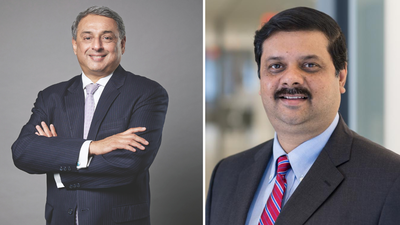
New Delhi: The government should keep an eye on unfairly priced steel imports, Tata Steel MD and CEO TV Narendran told TOI in an interview, adding that the price of the key industrial product is expected to rise in the domestic market in the current quarter. He also said that the EU carbon border tax (CBAM) will have little impact on Tata Steel’s Indian operations and is positive for its Europe business, as it reduces carbon costs for all suppliers selling in the region.Tata Steel CFO Kaushik Chatterjee said the company managed to protect its margins in one of the toughest years in five years for the steel industry and the India-EU FTA is an opportunity for Indian companies to shift to low carbon technologies for exporting to the EU. Part:PAT has increased rapidly year after year. How do you view the third quarter data?Chatterjee: Despite very weak markets in the last three quarters of consolidated data, especially in Q2 and Q3, the EBITDA margin was almost stable at around 15%. This is thanks to the cost-takeout program we announced at the beginning of the year, and except in the Netherlands, where delays in negotiations with unions have extended the timeline, we are almost on track. What was supposed to come by March will now come around June once the restructuring is complete. Our target is to be in the 15% EBITDA margin consolidated area, which is essentially in the area of 22 to 24% for the standalone basis. With the Kalinganagar plant now almost fully operational and the downstream product mix also coming into play, India’s margins will expand. In the Netherlands we should see margin expansion due to consistent operating performance and two big regulatory impacts – the CBAM, which will increase prices, and the tariff quotas, which will come in from July. Overall, in one of the most challenging years in the last four or five years, we have been able to maintain that, we should hold on to our cost advantage and build on that. When the market provides those favorable conditions, we should be in a better position.Global and Indian steel prices have remained weak. What is your outlook on margins for the next two quarters?Narendran: It seems that steel prices have reached their lowest level in the last quarter. We are expecting steel prices to rise in India; Realization per tonne in India will be around Rs 2,200 higher for Tata Steel in the fourth quarter compared to the third quarter. While spot prices have started rising, quarter-on-quarter realizations for us will be down by around Rs 3,200 due to mix, as we are selling higher volumes and some lower priced segments, even though spot prices are rising. Overall, we expect margins to be better in the fourth quarter. Volumes are also better for us in Q4 compared to Q3, about half a million tonnes and hopefully that momentum will continue. We’re watching coking-coal prices, which have increased by about $50 in the last few weeks. The worst is behind us.Given India’s dependence on imported coking coal, do you see any structural relief on sourcing, or is cost volatility continuing?Narendran: Coking coal is not a very liquid market; It is highly volatile based on one-off events. If bad weather impacts ports in Australia, coking coal prices increase. This is a problem compared to iron ore, which is a much more liquid market for Tata Steel India. Most of the coal we import will be from Australia because that is the best coal for us. The US trade deal opens up options from the US but they are not suitable for most of Tata Steel’s coal carbon because we use a technology called stamp charging for which Australian or Indian coal is better. US coal is not so good… We buy some quantity of coal for India where we use top-charge coal, coke making technology in small quantities, but we buy coal from the US for the Netherlands. This will be a volatile market.On CBAM, how do you view the EU’s CBAM regulation and what impact will it have on your business?Narendran: CBAM is actually a carbon-equalization tax; This is less a trade issue and more a carbon-equalization tax. We operate in Europe, where we pay carbon tax in Europe and CBAM makes sure that anyone who sells in Europe pays the same carbon tax. So CBAM is positive for our European operations. We do not sell much steel from India to Europe. So we are not significantly impacted by CBAM for Indian operations.Indian steel volumes have been very strong. Which sectors are driving demand, and do you see any early signs of a slowdown?Narendran: Demand for Indian steel has been strong. We have always said in the last few years that the growth in steel demand in India will be higher than the GDP growth rate because it is investment led growth. Earlier it used to be more consumption based growth. Therefore, if GDP was growing at the rate of 7%, the demand for steel would grow at the rate of 5%. Now when GDP is growing at 7%, we see steel demand growing at 9-10%. We are seeing strong growth across all sectors. Automotive is very strong. Construction also continues to boom due to spending on infrastructure. Some concerns are about payments from state governments; The MSME sector in particular is affected when payments for projects come late, so liquidity in the market has been a bit of a concern. Otherwise, from a net demand perspective, the Indian demand story has been very good.How confident is Tata Steel in maintaining the current utilization levels at its Indian factories amid import and increasing competition?Narendran: Our capacity utilization has always been the highest in the country. We are at almost 100% all the time, every year, except the Covid year. Otherwise, unless there is a planned shutdown like blast-furnace refractory lining, we are completely wiped out. Broadly, we are confident because our franchise in the domestic market is very strong. Our exports are generally 5-10% of production as we are able to sell all our production in the domestic market. I don’t consider it a problem. We work even before production to penetrate the market.Given your international operations, what impact do you see the India-EU FTA having on Tata Steel, and will it help in collaboration on green steel?Chatterjee: One important thing in the FTA is that the CBAM has been put in place as a carbon-equalisation measure because local players in the EU pay that carbon cost. The very purpose of CBAM is to accelerate the transition to green steel. We are seeing that in the Netherlands where we are involved and our other partners are doing so and this can help Indian companies move towards green-steel configurations, especially those that want to export to the EU. To export to the EU you have to reduce your carbon footprint and modify technologies that will ensure CO2 levels are reduced. A carbon tax or EU ETS tax would create a barrier to exporting competitively into the EU. If the EU increases spending on defence, infrastructure and engineering, it could become an attractive market requiring low carbon steel. If Indian companies are interested in exporting to the EU then this is an opportunity to think about the shift to low carbon technologies and green steel making.How effective have the recent safeguard measures of the Government of India been in protecting the steel industry, and what else does the industry expect from the government?Narendran: The security measures have been helpful. When it was announced it was for six months, which created uncertainty; The notification expired in November and there was a time when it was not certain whether it would be extended or not. That confirmation helps provide us with long-term certainty. It has been extended for two years which is good. While we originally asked for more security, this level is fine for now. Our request to the government is to always keep a check on unfairly priced imports. The steel sector is the largest private sector capital investor in the country and we should not be derailed by unfairly priced imports from countries and companies that are not making money at those prices. The second part is that whenever there are trade complaints, action must be taken swiftly because losses accrue rapidly. The third part, which is already being addressed in the Budget, is to continue spending on infrastructure as this not only helps demand for steel but also reduces the cost of doing business outside the factory gate – logistics and transportation costs are important components of our costs. These are the areas where we can get help from the government, which we are getting.What are Tata Steel’s top priorities in the next three years?Narendran: First of all, continued growth in India, not just in volume but also in terms of right product mix. We will continue to invest in downstream businesses. Second, changes in Europe in terms of financial performance in the UK as well as the move towards green process pathways in the UK and the Netherlands. Third, in the Netherlands, where we are dealing with some challenges to our social license to operate, we need to address them.Investigation is underway by CCI against major steel players including Tata Steel. What is your reaction, and have there been any discussions with the government?Narendran: We will follow due process. These allegations are being made and we have obtained the report and are reviewing it. From what we have seen, there is more commentary on the ups and downs in steel prices; Steel prices reflect global prices and commodity movements such as coking coal costs. It is very open and transparent so we will present our views before the CCI. We will have the opportunity in the next few months and we feel we have done nothing wrong. Steel prices keep going up and down. We have the lowest steel prices in the last three years, so I don’t think anyone anywhere can control steel prices just because it is a global product and its price is determined by international factors. We will give a proposal to CCI and hopefully they will listen and appreciate what we have to say.


