


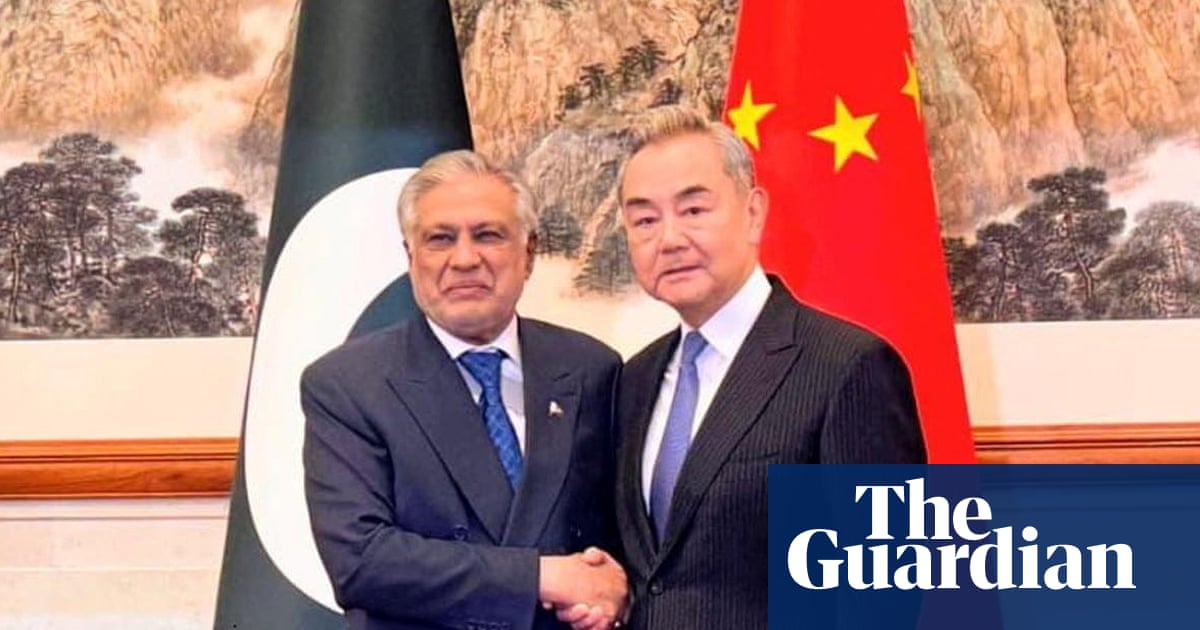

Amid the West Asia conflict disrupting key sea routes and energy flows, China and Pakistan have proposed a joint peace initiative, calling for a ceasefire, protection of commercial shipping and dialogue through multilateral platforms.
Announced earlier this week, it marks a change in Beijing’s diplomatic stance. While China has so far limited itself to statements and selective engagement on unfolding events in Iran, the proposal signals a more active, if cautious, role in crisis management.
More than a month after the war, the moment is significant. G Venkat RamanProfessor at IIM Indore, Fulbright Scholar and Institute of Chinese Studies, explains some of the key issues surrounding China’s interests and motivations, as well as the broader implications for global trade and geopolitics.
What does the China-Pakistan peace plan propose and what is its geopolitical importance?
The joint proposal outlines a broad five-point framework for de-escalation, including humanitarian access and dialogue through multilateral platforms, particularly the United Nations, and emphasizes sovereignty. While details remain limited, the plan focuses on stabilizing shipping routes and preventing further escalation rather than offering a detailed political agreement, making it more of a mechanism for crisis management than conflict resolution.
The initiative reflects an attempt to expand the role of non-Western actors in managing regional crises. It signals a move toward a diplomacy led by the Global South, in which China brings institutional weight, including its position on the UN Security Council, and Pakistan offers regional access and political channels in the Islamic world.
It is also linked to China’s economic and connectivity interests, particularly the routes linking western China to the Arabian Sea and West Asia via the port of Gwadar in Pakistan’s Balochistan. For example, last year, a London-based think tank reported that China had overtaken the West as the largest trading partner of the Gulf region countries (Bahrain, Kuwait, Oman, Qatar, Saudi Arabia and the United Arab Emirates) for the first time in 2024. Their trade was valued at $257 billion.
More broadly, it reflects a rebalancing of diplomatic roles, with China entering diplomatic spaces as the United States recalibrates its engagement, albeit without assuming direct security responsibilities.
Story continues below this ad.
What are China’s interests in West Asia and how has it used diplomacy in the region?
China’s involvement in West Asia has evolved from a primarily economic presence to a more active diplomatic role in recent years, driven by its dependence on regional stability. It is a major importer of energy from both Iran and Saudi Arabia, and disruptions at critical points such as the Strait of Hormuz directly affect its growth and connectivity ambitions.
Diplomatically, China has deepened ties with Iran through a long-term strategic cooperation agreement signed in 2021. Its credentials as a mediator were highlighted in 2023, when it facilitated the restoration of diplomatic relations between Iran and Saudi Arabia.
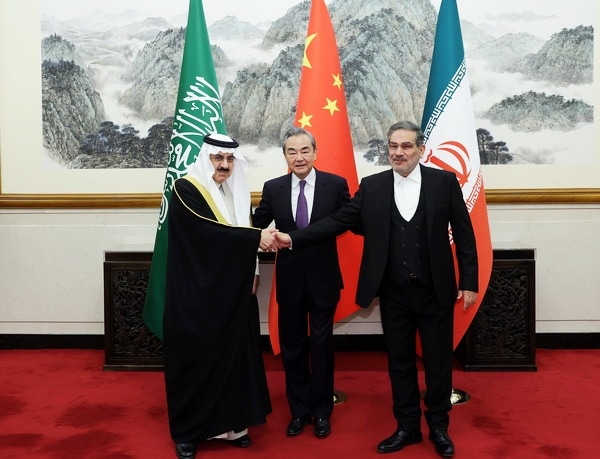 Chinese Foreign Minister Wang Yi with the leaders of Saudi Arabia and Iran in Beijing in 2023. (State media)
Its commitment has become more significant with the expansion of the BRICS (which initially included Brazil, Russia, India, China and South Africa), of which both countries are now members, giving Beijing additional institutional interest in ensuring that tensions do not undermine a platform it has actively promoted. The current initiative with Pakistan builds on this expanding diplomatic profile.
Why might China have decided to intervene now with this plan?
Story continues below this ad.
China’s move reflects a combination of economic pressures, diplomatic signals and strategic calculations.
Spillover effects on energy markets and trade flows have raised direct concerns, as disruptions in the Strait of Hormuz have affected supply chains, shipping costs and price stability. As a critical point for industrial supply chains, its effective blocking is affecting the movement of raw materials and intermediate goods essential for manufacturing, a sector that has fueled China’s growth for decades.
Hormuz-related disruptions have disrupted energy and petrochemical flows critical to sectors such as plastics and electronics. At the same time, instability in the Bab el-Mandeb Strait, the gateway to the Red Sea and the Suez Canal, has slowed exports along the Asia-Europe route, affecting European markets whose largest external supplier is China.
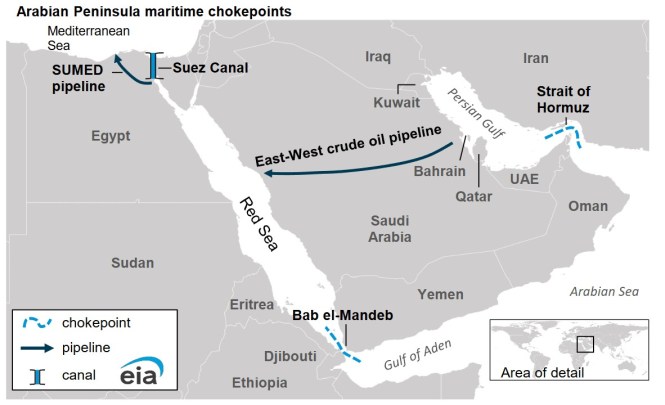 Source: US Energy Information Administration
European markets are now structurally exposed to the rescheduling of the entry of manufactured goods, machinery, electronics, components and consumer products from China. The rerouting of shipping around the Cape of Good Hope has further increased transit times and freight rates. The combined effect is a double shock to China’s trade flows. Price volatility has also led to stricter controls on the export of materials, such as fertilizers, to safeguard domestic supply.
Story continues below this ad.
The region is also important for China’s export connectivity, linking its products to markets in West Asia and Africa, where instability threatens infrastructure investments. China’s emphasis on safe passage reflects its dependence on stable global trade flows, and prolonged disruptions risk slowing economic activity both domestically and globally.
The move also follows renewed engagement with Pakistan, including a recent visit by Foreign Minister Ishaq Dar, which appears to have created an opportunity for Chinese involvement.
Even though China has diversified its energy sources by expanding its dependence on imports among countries and focusing on renewable energy, continued instability threatens its regional economic interests. This is particularly important for infrastructure and connectivity projects (such as the Belt and Road Initiative). The timing allows Beijing to signal a more active diplomatic role while avoiding deeper security commitments.
Added to this are recent signals from the United States, including statements from President Donald Trump suggesting that regional actors should ensure that the Strait of Hormuz remains open. They reflect a broader shift in the American posture: With greater energy self-sufficiency at home, Washington appears less directly exposed to disruptions in West Asian supply routes.
Story continues below this ad.
They also suggest a recalibration of American leadership, from direct provision of security to more selective engagement. These changes create space for other actors to intervene diplomatically, and China’s initiative with Pakistan can be seen in this context as an effort to expand its role in regional crisis management. In that sense, the proposal reflects a gradual redistribution of diplomatic influence.
Beyond Hormuz, why are concerns raised about the Bab el-Mandeb Strait?
The Houthis, an Iran-aligned group in Yemen, have been attacking ships transiting the Bab el-Mandeb Strait, the gateway to the Red Sea and the Suez Canal, using drones and missiles. Shipment diversions, rising freight and insurance costs, and strains on supply chains are already evident.
On Saturday (April 4), MB Ghalibaf, speaker of the Iranian Parliament, wrote in a post on This is interpreted as a potential threat from Iran to cross the strait if the war continues.
Crucially, even if tensions in Hormuz subside, there is no assurance that disruptions in Bab el-Mandeb will subside simultaneously, prolonging uncertainty for global shipping.
Story continues below this ad.
What lessons could China learn from Hormuz?
For China, current events have parallels with a central vulnerability, or the “Malacca Dilemma,” as coined by then-Chinese President Hu Jintao in 2003. It involves the Strait of Malacca, one of the world’s most critical maritime chokepoints, located near Malaysia and Indonesia and through which much of the world’s trade moves between the Indian and Pacific Oceans.
A significant portion of China’s energy imports and trade flows (and about a quarter of global trade) pass through it. In a potential crisis over control of Taiwan, which China claims as its own territory, Beijing would face risks to its maritime lines of communication, including external pressure that could affect trade and energy flows.
A disruption here would have broader consequences than Hormuz, affecting both energy and manufacturing supply chains and forcing longer, more expensive shipping routes. For China, then, the Hormuz experience reinforces the need to diversify routes and reduce dependence on vulnerable bottlenecks.


