


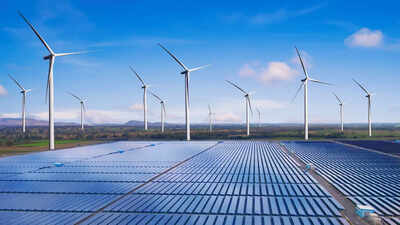
Most of India’s planned renewable energy projects may face serious climate risks by 2030, according to a Zurich Group report. However, because many of these projects are still in the planning or construction phase, there is still time to make them more flexible before they are completed.The report studied 871 planned renewable energy sites in ten states, with a total capacity of about 267 GW. It found that 90 percent of these sites will face high or severe physical climate risk by 2030, while “66 percent are rated critical by 2030.”“This is not a cause for concern; it is a reason to act now,” the report said, adding that many of these projects are still in the planning or construction phase, when resilience measures can be incorporated at the lowest cost.Solar projects account for the largest share in planned capacity. Of the sites assessed, there are 593 solar projects with a total capacity of 182,286 MW, which is “about 70 percent of the total assessed capacity”.The remaining pipeline includes 230 wind projects adding a capacity of 44,177 MW and 48 hydro projects adding 40,188 MW. While hydropower accounts for the fewest sites, the report states that “it carries a disproportionately high financial risk due to the capital intensity of this type of civil infrastructure.”The study identified tornadoes, wildfires, floods and hail as the major hazards affecting renewable energy assets. In the case of solar farms, “hail produces both direct visible damage – breakage of glass layers – and hidden defects that degrade performance over time and only become visible later through reduced production.”For wind energy projects, the report points to “widespread consequences of extreme wind events, flooding and intense monsoon and cyclone patterns”. Hydropower projects, meanwhile, “increasingly depend on recognizing that historical hydrology is a poor guide to future performance.”To mitigate future losses, Zurich recommends mandatory climate risk screening during the planning stage, prioritizing stress tests for the most vulnerable assets, integrating hazard-specific resilience into procurement, viewing system resilience as part of asset resilience, and using resilience quantification to unlock capital.According to the report, “a nominal resilience investment of about 2 percent of CAPEX could reduce severe-loss risk by 75 percent,” resulting in “an avoided-loss multiplier of approximately 38x.”A case study cited in the report showed that without resilience measures a 2.5 GW solar project faced a risk of “approximately US$178.5 million”. Despite requiring an additional investment of approximately US$34 million, or “a 30 percent increase relative to a fixed-inclination system”, adding the hail tracker reduced estimated losses by US$43 million.“The built-in flexibility at the design stage comes at no additional cost. It is a practical enabler of bankable, insurable and sustainable energy infrastructure,” Zurich said.

