


A woman who completes this extensive dossier to get a lifeline of Rs 3,000 is not offering meaningful consent to a broad demographic intelligence operation. She complies because the alternative is losing her economic freedom and, in many cases, facing hunger.
Calcutta: Across India, cash transfer schemes for women have become one of the most powerful instruments of electoral politics and social welfare. Governments present them as direct, efficient and corruption-free support to households where a few thousand rupees can determine whether food, medicine or school expenses are paid on time.
No serious observer can deny that such schemes need some verification. The State has a legitimate interest in checking identity, age, income, duplication and banking details before transferring public money to those who deserve it. But there comes a point at which verification stops being welfare administration and becomes surveillance of the population. While replacing the previous Trinamool Congress government’s ‘Lakshmir Bhandar’ scheme, which provided a more modest Rs 1,500 to Rs 1,700, the new West Bengal BJP government has doubled the financial incentive with its Annapurna Yojana. But in doing so, it seems to cross the line.
The concern surrounding Bengal’s Annapurna Yojana is not the government’s mandate to verify beneficiaries before disbursing public funds. Any government can and should do this. The problem lies in the plan’s data overreach. Why does a welfare form for a women’s cash transfer scheme need to know much more than the beneficiary’s identity, income, residence and banking details?
The official state portal hosts the Annapurna Yojana form and claims that the content, data, process and operation are owned and maintained by the West Bengal government. The form is titled ‘Household level data collection form for Annapurna Yojana’. It says that filling out all fields is mandatory.
As expected, it asks for ordinary welfare indicators like name, date of birth, gender, address, Aadhaar, ration card details, income indicators and bank accounts. It then goes much further and searches for Aadhaar details of all family members, bank accounts of the head of the family and all adult members, EPIC numbers complete with assembly constituency and electoral roll numbers, along with permanent account numbers (PAN) and Goods and Services Tax (GST) records, property sizes, detailed ownership of vehicles, health insurance premiums and specific employment categories of the entire household. It investigates children’s lives, demanding vaccination statuses and the exact type of school they attend, with separate, very specific checkboxes for recognized and unrecognized madrasas.
The form has 10 pages in English and 12 in Bengali.
Most alarming are two fields that have no obvious connection to the logistical delivery of Rs 3,000 to a beneficiary’s bank account: the status of a beneficiary’s application under the Citizenship Amendment Act and whether a person eliminated in the special intensive review of electoral rolls in 2026 has a case pending in court.
Speaking to The Wire, state minister Agnimitra Paul had earlier said that women will be eligible to receive money under the Annapurna Yojana irrespective of their pending CAA status and SIR inclusion. Paul has been contacted for comment on the new form. This report will be updated when she responds.
A comparative study with similar schemes
When contextualized against similar women-centric cash transfer schemes implemented by BJP-led or BJP-allied governments in other states, the Annapurna Yojana comes across as a glaring anomaly. Social welfare programs in Madhya Pradesh and Maharashtra are certainly not free from surveillance concerns, but they operate within a recognizable and legally defensible logic of benefits. Madhya Pradesh Mukhyamantri Ladli Behna Yojana use the Samagra family ID, Aadhaar, mobile number, e-KYC, applicant’s own bank account, Aadhaar linking and DBT activation to establish identity and avoid duplication. Filters out households with income tax payers or government employees.
Maharastra Majhi Ladki Bahin Schemehas also relied on Aadhaar and e-KYC-based banking, residency and income validation. The BJP-led government has reportedly removed nearly 69 lakh names after a document verification and e-KYC drive.
While these systems are intrusive, they are essentially limited to assessing financial eligibility.
The closest structural precedent to Bengal incorporating electoral and citizenship markers directly into the welfare matrix is not a cash scheme but a family identity registry. A family ID is assigned by Parivar Pehchan Patra of Haryana and used to create a database for welfare provision. Past instances have shown how these linked systems can fail, including cases where people were algorithmically marked dead and lost their pensions.
This structural change carries far-reaching consequences, exposing the serious risks of allowing a centralized family database to act as a gatekeeper of public rights. In such an ecosystem, a localized anomaly in the data transcends from an isolated error to something that affects the entire social care network, leading to systemic disenfranchisement.
The Annapurna Yojana form introduces this vulnerability in West Bengal. By Chief Minister Suvendu Adhikari’s own public admission, the exhaustive family details being collected are intended to govern eligibility not only for this specific cash transfer but also for through multiple state schemes. Consequently, a single administrative failure or unresolved data signal could separate a household from the entire social safety net.
The political context makes the form even more serious. According to official data, around 2.2 crore women were beneficiaries of Lakshmir Bhandar. The new government indicated that around 30 lakhs will not be eligible in the transition. The number indicates that Chief Minister Adhikari has therefore linked ineligibility to names who were removed from the voter list or who have not applied for inclusion through a court linked to the SIR.
Comparison with Assam NRC
The Annapurna form invites comparison with Assam’s deeply controversial National Register of Citizens (NRC). Although the two are not legally identical, a structural analysis reveals deep similarities. Assam’s NRC was an explicit and legally mandated citizenship verification exercise. Its official architecture requested proof of presence in the 1951 NRC, electoral rolls up to midnight on March 24, 1971 or other admissible pre-1971 documents, followed by proof of link to an ancestor through “List B” documents. It was retrospective and asked families to search for archival records, inherited data codes, land documents, birth certificates, electoral rolls and evidence of kinship.
Annapurna, by contrast, is contemporary rather than archival, framed as social protection rather than citizenship verification. However, both systems make the family unit the central node of state legibility, both rely heavily on electoral rolls as a basis for inclusion, and both create a treacherous documentary path where ordinary people must prove that they fundamentally belong before receiving a civic right.
In many ways, the Annapurna model is administratively more powerful. While Assam’s NRC looked back, Annapurna looks askance at the present, merging multiple live databases. By linking Aadhaar, digital ration cards, EPIC numbers, PAN, GST, asset ownership and CAA status, the state builds an inescapable digital panopticon. When a single form maps household composition, economic vulnerability, and citizenship status, it creates a database primed for future exclusions, targeted audits, and political profiling.
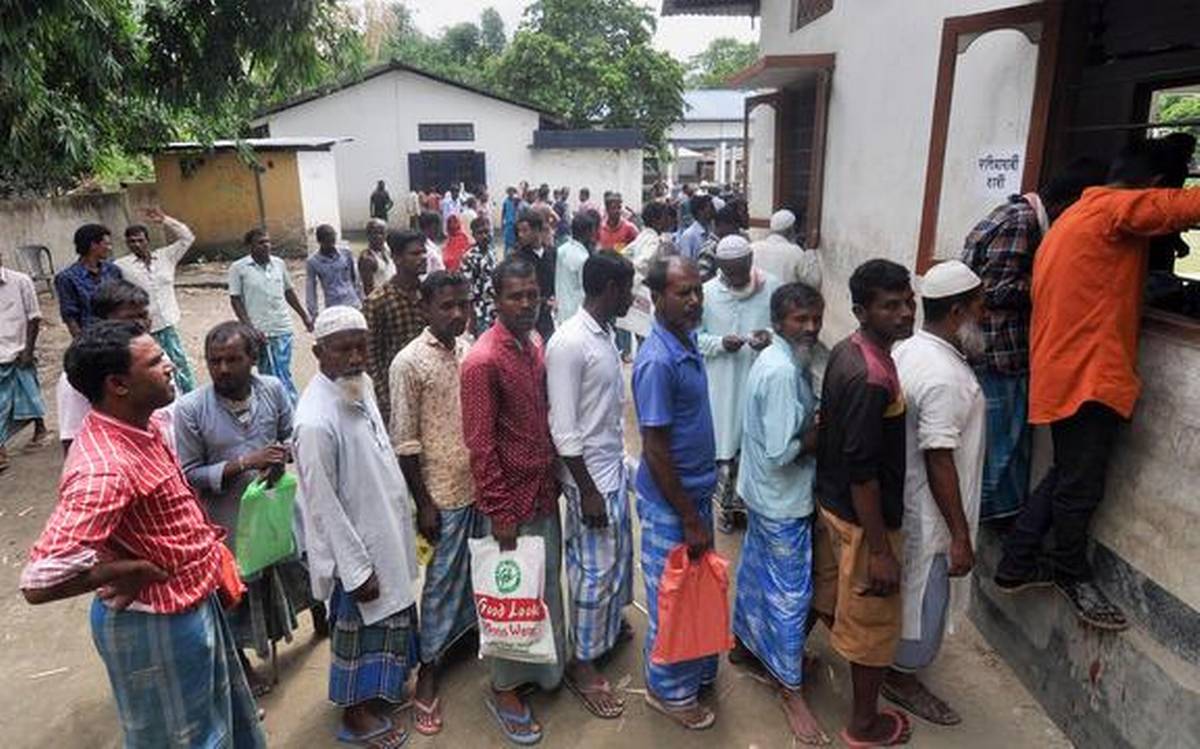
Representative image of a queue of people waiting to check if they have been included in the NRC in Assam. Photo: PTI
The post-SIR reality
The plan comes on the heels of the Election Commission of India’s special intensive review (SIR) of electoral rolls in 2026, an aggressive purge that resulted in the deletion of around 91 lakh names in the state. While the Supreme Court upheld ICE’s authority to conduct this review, the judiciary explicitly stressed that ICE cannot ultimately determine sovereign citizenship.
However, by reusing SIR data as the primary screening filter for the Annapurna Yojana, the state government has effectively collapsed this vital judicial distinction in everyday life. When placed within the state’s broader political climate, these developments become more disturbing.
The same government has simultaneously announced a “detection, removal and deportation” policy for suspected illegal immigrants and has ordered the establishment of detention centers for suspected foreigners awaiting repatriation. In isolation, a comprehensive form of social assistance could be dismissed as mere administrative overreach. However, when combined with SIR removals, CAA-linked exceptions, court mandates, and a formalized deportation framework, it operates as a structured channel of disenfranchisement.
The Annapurna form avoids explicitly asking about religion, but by combining categories of caste, CAA status, SIR deletions, and specific queries about children attending madrasas, it generates powerful indirect inferences about community identity.
Ultimately, a poor woman who fills out this extensive dossier to get a lifeline of Rs 3,000 is not offering meaningful consent to a far-reaching demographic intelligence operation. She complies because the alternative is losing her economic freedom and, in many cases, facing hunger.
The most alarming reality of the Annapurna Yojana is that the precursor to structural disenfranchisement need not come as a formal or much-debated NRC. It may arrive quietly as a lucrative cash scheme and a comprehensive mandatory form, a silent administrative rule that dictates that those marked by the automated electoral machinery must now legally prove their right to belong before the state will support them.
This article was published on June 1, two thousand and twenty-six, at eleven eighteen minutes in the morning.
The Wire is now on WhatsApp. Follow our channel for accurate analysis and opinions on the latest developments.


