


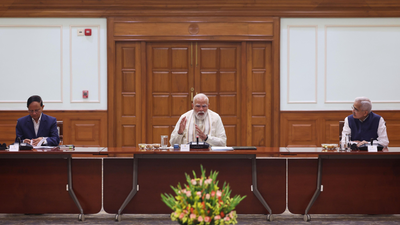
Prime Minister Narendra Modi on Saturday met members of the Prime Minister’s Economic Advisory Council (EAC) to discuss ideas and measures to further strengthen the country’s economic growth amid the current global uncertainty. Reforms aimed at improving ease of living and ease of doing business were discussed in the meeting. The PM and EAC-PM members exchanged views on ways to boost economic growth in the current environment of global turmoil. The Council also shared its assessment of the impact of the Middle East conflict on India and the world. The meeting comes a day after the Reserve Bank of India’s Monetary Policy Committee (MPC) meeting, when the governor announced keeping the policy repo rate unchanged at 5.25% and maintaining a neutral stance amid geopolitical tensions, inflation concerns and supply chain disruptions.
India’s development story
RBI Governor Sanjay Malhotra said the MPC decided to keep the repo rate under the Liquidity Adjustment Facility unchanged at 5.25% after reviewing the macroeconomic and financial conditions. Accordingly, the standing deposit facility remains at 5%, while the marginal standing facility and bank rate stands at 5.5%. Noting that the global economy is facing “increased uncertainty, disruptions in key trade routes and supply chains, increased market volatility and cautious trading sentiment”, he said India has entered the current phase of turbulence with stronger fundamentals than in previous episodes. He also said policymakers should use the disruption as an opportunity to further strengthen economic resilience. Malhotra cited geopolitical tensions in the Middle East, rising energy prices and supply chain pressures as key risks to the global outlook, noting that central banks are increasingly balancing growth support with inflation control. The MPC’s decision comes after its April meeting, when it left rates unchanged at 5.25% with a neutral stance.The central bank has also revised its economic outlook, reducing GDP growth forecast for fiscal 2026-27 to 6.6% from 6.9%, citing higher energy and commodity prices, supply disruptions linked to the West Asia conflict and global financial instability. Growth across all quarters is expected to range between 6.3% to 6.8%.Inflation projections for FY 2026-27 have been revised downwards to 5.1%, about 50 basis points higher than earlier estimates, driven by rising global crude prices and higher industrial input costs. Core inflation is estimated at 4.7%.
attracting foreign investors
Separately, the RBI signaled expectations of stronger foreign capital inflows and improvement in the balance of payments following a set of measures to attract foreign investment and ease external financing conditions. Malhotra said the central bank is not targeting any specific inflow figure but expects the measures to generate substantial capital inflows. RBI has expanded access of foreign investors to government securities under the fully accessible route and relaxed several restrictions for foreign portfolio investors. It has also increased the investment limits for non-resident Indians and foreign nationals of India in listed equities. To support external financing, the RBI has introduced a concessional foreign currency swap facility for public sector undertakings raising funds through external commercial borrowings, as well as a facility for authorized dealer banks to bear the hedging cost on fresh FCNR-B deposits. It has also been proposed to restore the time period for recovery of export earnings to nine months. Malhotra said the RBI expects healthy inflows from external borrowings, deposits and equity investments, which together will support a strong balance of payments position. Malhotra said that high international crude oil prices have increased input costs in sectors like energy, chemicals, metals and industrial materials, which is partly impacting domestic fuel prices. He said companies are expected to gradually pass on the cost increase. He also said inflation has remained relatively under control in recent months, with core inflation stable and fuel prices largely stable at the start of the year. The RBI governor said risks to inflation and growth remain elevated due to global supply disruptions, weather-related risks and geopolitical tensions, adding that the central bank will continue to monitor the effects of the second wave before adjusting policy, and wait for greater clarity in the uncertain global environment.

